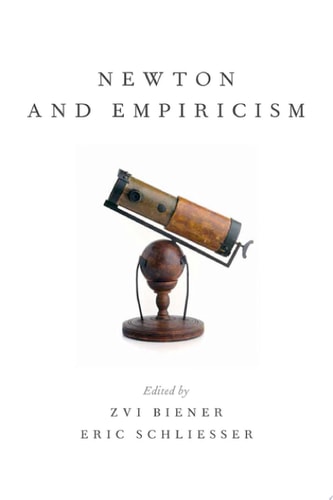
Newton and Empiricism
0
0
As an Amazon Associate and affiliate partner, Menrva Books earns from qualifying purchases. Learn more
Author Description
This volume of original papers by a leading team of international scholars explores Isaac Newton's relation to a variety of empiricisms and empiricists. It includes studies of Newton's experimental methods in optics and their roots in Bacon and Boyle; Locke's and Hume's responses to Newton on the nature of matter, time, the structure of the sciences, and the limits of human inquiry. In addition it explores the use of Newtonian ideas in 18th-century pedagogy and the life sciences. Finally, it breaks new ground in analyzing the method of evidential reasoning heralded by the Principia, its nature, strength, and development in the subsequent three centuries of gravitational research. The volume will be of interest to historians of science and philosophy and philosophers interested in the nature of empiricism.
Menrva's Summary
THE THESIS
This volume investigates the complex relationship between Isaac Newton’s scientific methodology and the development of empiricist philosophy. Edited by Eric Schliesser and Zvi Biener, the book compiles original research from international scholars to examine how Newton’s experimental practices influenced both his contemporaries and subsequent thinkers. The contributors analyze the intersection of Newtonian physics with the philosophical frameworks of figures such as Locke and Hume, while evaluating the long-term impact of the Principia on evidential reasoning.
THE SCOPE MAP
What You Will Find
- Analysis of Newton’s experimental methods in optics and their historical roots in the works of Bacon and Boyle.
- Comparative studies of Locke’s and Hume’s philosophical responses to Newtonian concepts of matter, time, and scientific structure.
- Investigations into the application of Newtonian ideas within 18th-century pedagogy and the life sciences.
- A technical evaluation of the method of evidential reasoning established in the Principia and its evolution over three centuries of gravitational research.
THE AUTHORITY PERSPECTIVE
Scholars and historians of science identify this volume as a significant contribution to the study of early modern philosophy and scientific methodology. Readers frequently note the academic density of the prose, which is intended for researchers and students specializing in the history of science and epistemology.
Page Count:
384
Publication Date:
2014-01-01
Publisher:
Oxford University Press
ISBN-10:
0199337101
ISBN-13:
9780199337101
Science
Philosophy
Epistemology
Empiricism
Physics
History & Surveys
Community Tags
Similar Books