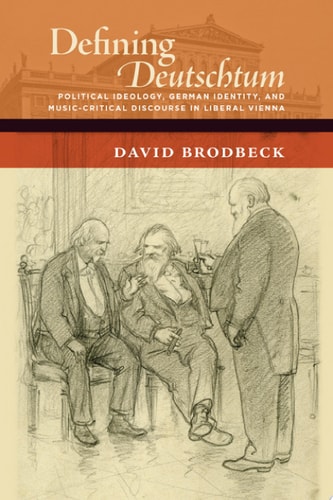
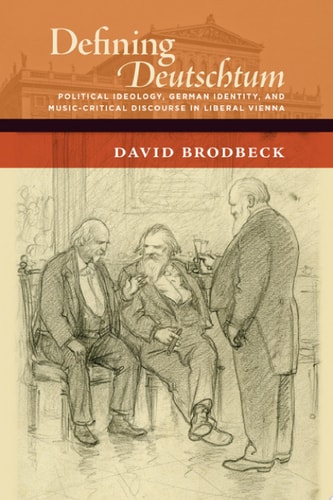
Defining Deutschtum: Political Ideology, German Identity, and Music-Critical Discourse in Liberal Vienna
0
0
As an Amazon Associate and affiliate partner, Menrva Books earns from qualifying purchases. Learn more
Author Description
Defining Deutschtum: Political Ideology, German Identity, and Music-Critical Discourse in Liberal Vienna offers a nuanced look at the intersection of music, cultural identity, and political ideology in late-nineteenth-century Vienna. Drawing on an extensive selection of writings in the city's political press, correspondence, archival documents, and a large body of recent scholarship in late Habsburg cultural and political history, author David Brodbeck argues that Vienna's music critics were important agents in the public sphere whose writings gave voice to distinct, sometimes competing ideological positions. These conflicting positions are exemplified especially well in their critical writings about the music of three notable composers of the day who were Austrian citizens but not ethnic Germans: Carl Goldmark, a Jew from German West Hungary, and the Czechs Bedřich Smetana and Antonín Dvořák. Often at stake in the critical discourse was the question of who and what could be deemed “German” in the multinational Austrian state. For critics such as Eduard Hanslick and Ludwig Speidel, traditional German liberals who came of age in the years around 1848, “Germanness” was an attribute that could be earned by any ambitious bourgeois-including Jews and those of non-German nationality-by embracing German cultural values. The more nationally inflected liberalism evident in the writings of Theodor Helm, with its particularist rhetoric of German national property in a time of Czech gains at German expense, was typical of those in the next generation, educated during the 1860s. The radical student politics of the 1880s, with its embrace of racialist antisemitism and irredentist German nationalism, just as surely shaped the discourse of certain young Wagnerian critics who emerged at the end of the century. This body of music-critical writing reveals a continuum of exclusivity, from a conception of Germanness rooted in social class and cultural elitism to one based in blood.
Menrva's Summary
THE THESIS
This book investigates how music-critical discourse in late-nineteenth-century Vienna functioned as a primary vehicle for defining and contesting the meaning of German identity within the multinational Habsburg Empire. Author David Brodbeck, a scholar of music history, synthesizes archival research, political press records, and correspondence to demonstrate that music critics were not merely aesthetic commentators but active participants in the political sphere. He argues that the shifting definitions of 'Deutschtum'—ranging from bourgeois cultural assimilation to racialist nationalism—mirrored the broader political fragmentation of the era.
THE SCOPE MAP
What You Will Find
- Analysis of music criticism in the context of late Habsburg political history.
- Examination of the reception of composers Carl Goldmark, Bedrich Smetana, and Antonin Dvorak.
- Comparative study of critical perspectives from Eduard Hanslick, Ludwig Speidel, and Theodor Helm.
- Exploration of the transition from liberal cultural elitism to radical racialist antisemitism in public discourse.
THE AUTHORITY PERSPECTIVE
Scholars recognize this work as a significant contribution to the intersection of musicology and political history, particularly for its detailed mapping of the Viennese public sphere. Readers frequently note the academic density of the prose and the depth of the archival evidence provided to support the author's arguments.
Page Count:
392
Publication Date:
2014-01-01
Publisher:
Oxford University Press
ISBN-10:
0199362718
ISBN-13:
9780199362714
History
Cultural History
Humanities
European History
Musicology
Chamber
Music Criticism
Community Tags
Other Editions(3)

Similar Books

Reader Comments
Share Your Thoughts
No comments yet. Be the first to share your thoughts!