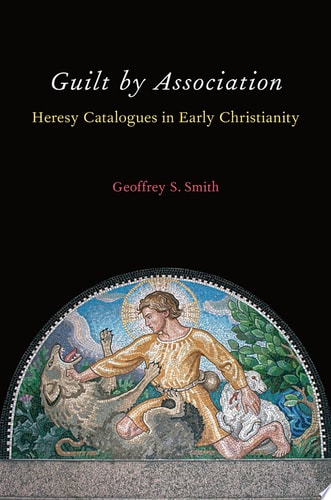
Guilt by Association: Heresy Catalogues in Early Christianity
0
0
As an Amazon Associate and affiliate partner, Menrva Books earns from qualifying purchases. Learn more
Author Description
Few literary innovations have exercised as much influence upon Christian attitudes toward internal diversity as has the practice of organizing the names and alleged misdeeds of rival teachers into heresy catalogues. For two millennia, followers of Jesus have employed the heresy catalogue as a powerful weapon in internal struggles for legitimacy, authority, and supremacy. Despite its enduring popularity and influence within the Christian tradition, the heresy catalogue remains an underappreciated polemical genre among historians of early Christianity. Guilt by Association explores the creation, publication, and circulation of heresy catalogues by second- and early third-century Christians. Polemicists made use of these religious blacklists, which include the names of heretical teachers along with summaries of their unsavory doctrines and nefarious misdeeds, in order to discredit opponents and advocate their expulsion from the "authentic" Christianity community. The heresy catalogue proved to be especially effective because it not only recast rival teachers as menacing adversaries, but also reinforced such characterizations by organizing otherwise unaffiliated teachers into coherent intellectual, social, and scholastic communities that are established and sustained by demonic powers.Geoffrey Smith focuses especially on the earliest Christian heresy catalogues, including those found within the works of Justin, Irenaeus, and Hegesippus, to shed new light upon the complex process through which early Christianity took shape.
Menrva's Summary
THE THESIS
This work investigates how the development and deployment of heresy catalogues functioned as a primary mechanism for defining orthodoxy and marginalizing dissent in early Christianity. Geoffrey S. Smith, a scholar of early Christian history, examines the rhetorical and social strategies employed by second- and third-century polemicists. By analyzing the construction of these religious blacklists, the author argues that these texts were not merely descriptive but were active tools used to consolidate authority and enforce communal boundaries. The study utilizes a historical-critical framework to demonstrate how the grouping of rival teachers served to discredit them through association with demonic influence.
THE SCOPE MAP
What You Will Find
- Analysis of the creation, publication, and circulation of heresy catalogues in the second and early third centuries.
- Examination of specific polemical works by figures such as Justin, Irenaeus, and Hegesippus.
- Exploration of the rhetorical techniques used to link unaffiliated teachers into coherent, demonically-sustained groups.
- Investigation into the socio-political processes that shaped the definition of authentic Christianity.
THE AUTHORITY PERSPECTIVE
Scholars recognize this text as a significant contribution to the study of early Christian polemics and the formation of ecclesiastical identity. Readers frequently note the academic rigor of the analysis, which provides a nuanced understanding of how heresy catalogues functioned as instruments of power rather than objective historical records.
Page Count:
216
Publication Date:
2014-01-01
Publisher:
Oxford University Press
ISBN-10:
019938679X
ISBN-13:
9780199386796
Religion
History
Theology
Christianity
Christian literature
Ancient History
Theology doctrinal
Bibles
Community Tags
Other Editions(2)

Similar Books