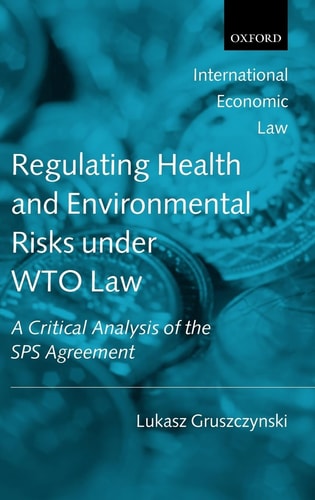
Regulating Health and Environmental Risks under WTO Law: A Critical Analysis of the SPS Agreement
0
0
As an Amazon Associate and affiliate partner, Menrva Books earns from qualifying purchases. Learn more
Author Description
The last sixty years witnessed an unprecedented expansion of international trade. The system created by the General Agreement on Tariffs and Trade and later by the World Trade Organization (WTO) has proved to be an efficient instrument for the elimination of trade and tariff barriers. This process coincided with increased national regulatory controls, which were particularly visible in the area of risk regulation. Governments, responding to the demands of their domestic constituencies, have adopted a wide range of regulatory measures aimed at protecting the environment and human health. Although, for the most part, the new regulatory initiatives served legitimate objectives, it has also turned out that internal measures might become an attractive vehicle for protectionism, taking the place that was traditionally occupied by tariff barriers. Regulating Health and Environmental Risks under the WTO Law examinesthe WTO Agreement on the Application of Sanitary and Phytosanitary Measures (SPS Agreement). In which it is an attempt by the international community to limit possible abuses while assuring WTO Members of an extensive margin of regulatory discretion.The central problem that the book tackles is whether the system established by the SPS Agreement can address the existing and potential challenges of a new interdependent world. In answering this question, the author provides a comprehensive and critical examination of the substantive provisions of the Agreement and corresponding case law. In this context, the book particularly focuses on two issues: the consistency in the interpretation of the SPS Agreement and the appropriateness of its various requirements. This analysis leads the author to conclude that despite some interpretative failures of SPS case law, the system established by the SPS Agreement seems to provide an effective solution for the supervision of domestic SPS measures.
Menrva's Summary
THE THESIS
This book investigates whether the regulatory framework established by the WTO Agreement on the Application of Sanitary and Phytosanitary Measures (SPS Agreement) is sufficient to manage the complex health and environmental risks of an interdependent global economy. Lukasz Gruszczynski, an expert in international economic law, evaluates the tension between national regulatory autonomy and the prevention of protectionist trade barriers. By analyzing the substantive provisions of the SPS Agreement alongside relevant WTO case law, the author assesses the efficacy of current international oversight mechanisms. The work argues that while interpretative inconsistencies exist, the existing system remains a functional tool for supervising domestic health and environmental regulations.
THE SCOPE MAP
What You Will Find
- A detailed examination of the WTO Agreement on the Application of Sanitary and Phytosanitary Measures.
- Analysis of the balance between national regulatory discretion and international trade obligations.
- A critical review of WTO case law regarding health and environmental risk regulation.
- An assessment of how domestic regulatory measures can function as disguised protectionism.
THE AUTHORITY PERSPECTIVE
Legal scholars and practitioners view this text as a rigorous examination of the intersection between trade law and public policy. Readers frequently note the academic density of the prose, making it a valuable resource for those studying the practical application of WTO dispute settlement mechanisms.
Page Count:
360
Publication Date:
2010-04-30
Publisher:
Oxford University Press
ISBN-10:
0199578923
ISBN-13:
9780199578924
Economics
Law
Public Health
International Law
Food Adulteration And Inspection
Community Tags
Similar Books