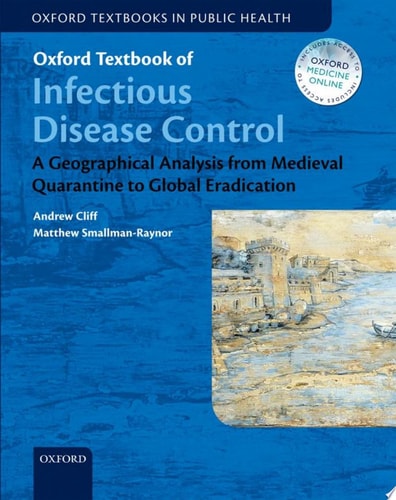
Oxford Textbook of Infectious Disease Control: A Geographical Analysis from Medieval Quarantine to Global Eradication
0
0
As an Amazon Associate and affiliate partner, Menrva Books earns from qualifying purchases. Learn more
Author Description
Oxford Textbook of Infectious Disease Control: A Geographical Analysis from Medieval Quarantine to Global Eradication is a comprehensive analysis of spatial theory and the practical methods used to prevent the geographical spread of communicable diseases in humans. Drawing on current and historical examples spanning seven centuries from across the globe, this indispensable resource demonstrates how to mitigate the public health impact of infections in disease hotspots and prevent the propagation of infection from such hotspots into other geographical locations.Containing case studies of longstanding global killers such as influenza, measles and poliomyelitis, through to newly emerged diseases like SARS and highly pathogenic avian influenza in humans, this resource integrates theory, data and spatial analysis and locates these quantitative analyses in the context of global demographic and health policy change. Beautifully illustrated with over 100 original maps and diagrams to aid understanding and assimilation, in six sections the authors examine surveillance, quarantine, vaccination, and forecasting for disease control. The discussion covers theoretical approaches, techniques and systems central to mitigating disease spread, and methods that deliver practical disease control.Essential information is also provided on the geographical eradication of diseases, including the design of early warning systems that detect the geographical spread of epidemics, enabling students and practitioners to design spatially-targeted control strategies.Despite the early hope of eradication of many communicable diseases after the global eradication of smallpox by1979, the world is still working at the control and elimination of the spatial spread of newly-emerging and resurgent infectious diseases. Learning from past examples and incorporating modern surveillance and reporting techniques that are used to design value-for-money spatially-targeted interventions to protect public health, the Oxford Textbook of Infectious Disease Control is an essential resource for all those working in, or studying ways to control the spread of communicable diseases between humans in a timely and cost-effective manner.This online version allows access to the full content of the textbook, provides links from all references through to primary research journal articles, allows full text searches and access to the 205 figures that can be downloaded for PowerPoint presentations. It is ideal for specialists and students in infectious disease control as well as those in the medical sciences, epidemiology, demography, public health and medical history.
Menrva's Summary
THE THESIS
This text investigates the spatial dynamics of infectious disease transmission and the efficacy of geographical strategies employed to contain or eradicate communicable pathogens. Authors Matthew R. Smallman-Raynor and Professor Andrew Cliff utilize a historical and quantitative framework to analyze how disease hotspots function and how public health interventions can be spatially targeted to prevent global propagation. By synthesizing seven centuries of data, the authors provide a comprehensive model for understanding the intersection of demographic shifts, health policy, and geographical surveillance.
THE SCOPE MAP
What You Will Find
- Historical analysis of disease control methods from medieval quarantine to modern eradication efforts.
- Quantitative spatial theory and modeling techniques for tracking epidemic spread.
- Case studies of global pathogens including influenza, measles, poliomyelitis, and SARS.
- Methodologies for designing early warning systems and spatially-targeted public health interventions.
THE AUTHORITY PERSPECTIVE
Experts recognize this work as a foundational reference for students and practitioners in public health and medical geography. Readers frequently note the academic density of the prose and the high utility of the included maps and diagrams for visualizing complex epidemiological data.
Page Count:
208
Publication Date:
2013-05-19
Publisher:
Oxford University Press
ISBN-10:
0199596611
ISBN-13:
9780199596614
Science
Medicine
Epidemiology
Epidemics
Public Health
Geography
Community Tags
Other Editions(2)
Similar Books













Reader Comments
Share Your Thoughts
No comments yet. Be the first to share your thoughts!