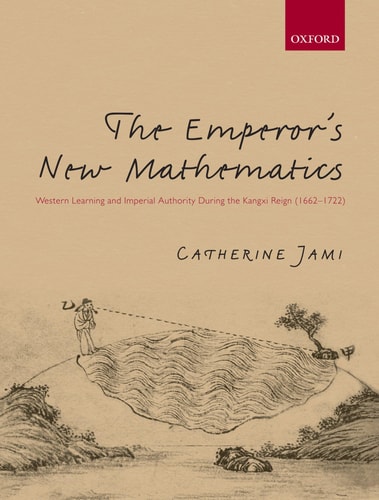
The Emperor's New Mathematics: Western Learning and Imperial Authority During the Kangxi Reign (1662-1722)
0
0
As an Amazon Associate and affiliate partner, Menrva Books earns from qualifying purchases. Learn more
Author Description
In 1644 the Qing dynasty seized power in China. Its Manchu elite were at first seen by most of their subjects as foreigners from beyond the Great Wall, and the consolidation of Qing rule presented significant cultural and political problems, as well as military challenges. It was the Kangxi emperor (r. 1662-1722) who set the dynasty on a firm footing, and one of his main stratagems to achieve this was the appropriation for imperial purposes of the scientific knowledge brought to China by the Jesuit mission (1582-1773).For almost two centuries, the Jesuits put the sciences in the service of evangelization, teaching and practising what came to be known as 'Western learning' among Chinese scholars, many of whom took an active interest in it. After coming to the throne as a teenager, Kangxi began his life-long intervention in mathematical and scientific matters when he forced a return to the use of Western methods in official astronomy. In middle life, he studied astronomy, musical theory and mathematics, with Jesuits as his teachers. In his last years he sponsored a great compilation covering these three disciplines, and set several of his sons to work on this project. All of this activity formed a vital part of his plan to establish Manchu authority over the Chinese. This book explains why Kangxi made the sciences a tool for laying the foundations of empire, and to show how, as part of this process, mathematics was reconstructed as a branch of imperial learning.
Menrva's Summary
THE THESIS
This book investigates how the Kangxi emperor utilized Western mathematical and scientific knowledge as a strategic instrument to consolidate Manchu authority and legitimize Qing rule in China. Catherine Jami, a historian specializing in the history of science in China, draws upon extensive archival research and primary source documentation from the Qing court. She argues that the emperor's personal engagement with Jesuit-introduced sciences was not merely an intellectual pursuit, but a calculated political maneuver to integrate foreign expertise into the framework of imperial governance. By reconstructing mathematics as a branch of imperial learning, the Kangxi emperor effectively transformed scientific practice into a symbol of his own legitimacy and administrative control.
THE SCOPE MAP
What You Will Find
- An analysis of the intersection between Jesuit missionary activities and Qing political strategy during the 17th and 18th centuries.
- A detailed examination of the Kangxi emperor's personal education in astronomy, musical theory, and mathematics.
- Historical evidence derived from imperial records, court documents, and the compilation projects sponsored by the Qing dynasty.
- An exploration of how scientific knowledge was institutionalized to reinforce the cultural and political standing of the Manchu elite.
THE AUTHORITY PERSPECTIVE
Scholars in the field of Chinese history and the history of science recognize this work as a definitive study on the political utility of knowledge in the Qing court. Readers frequently note the academic density of the prose, which provides a rigorous and nuanced account of the complex relationship between the emperor and his Jesuit tutors.
Page Count:
496
Publication Date:
2012-02-20
Publisher:
Oxford University Press
ISBN-10:
0199601402
ISBN-13:
9780199601400
Biography
History
Science
Mathematics
Mathematics - General
Science china
Mathematics history
Mathematics Statistics
China
Asian History
Community Tags
Similar Books