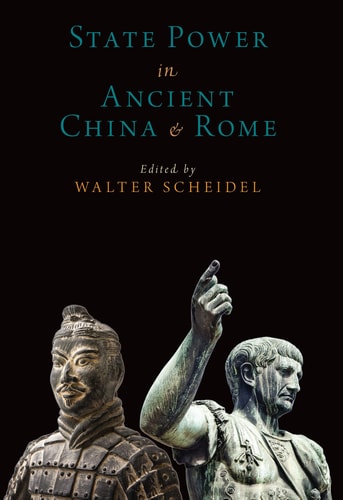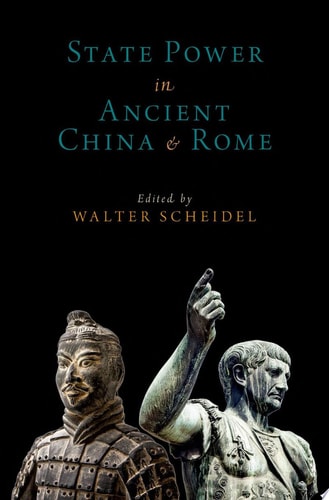
State Power in Ancient China and Rome
0
0
As an Amazon Associate and affiliate partner, Menrva Books earns from qualifying purchases. Learn more
Author Description
Two thousand years ago, the Qin/Han and Roman empires were the largest political entities of the ancient world, developing simultaneously yet independently at opposite ends of Eurasia. Although their territories constituted only a small percentage of the global land mass, these two Eurasian polities controlled up to half of the world population and endured longer than most pre-modern imperial states. Similarly, their eventual collapse occurred during the same time.The parallel nature of the Qin/Han and Roman empires has rarely been studied comparatively. Yet here is a collection of pioneering case studies, compiled by Walter Scheidel, that sheds new light on the prominent aspects of imperial state formation. This essential new volume builds on the foundation of Scheidel's Rome and China (2009), and opens up a comparative dialogue among distinguished scholars. They provide unique insights into the complexities of imperial rule, including the relationship between rulers and elite groups, the funding of state agents, the determinants of urban development, and the rise of bureaucracies. By bringing together experts in each civilization, State Power in Ancient China and Rome provides a unique forum to explore social evolution, helping us further understand government and power relations in the ancient world.
Menrva's Summary
THE THESIS
This volume investigates the comparative mechanisms of state power and imperial formation in the Qin/Han and Roman empires to understand why these two distinct entities achieved such longevity and scale. Walter Scheidel, a prominent historian of the ancient world, assembles a group of specialized scholars to analyze the structural parallels between these Eurasian empires. The work utilizes a comparative framework to examine how both states managed elite relations, bureaucratic expansion, and resource extraction across vast territories.
THE SCOPE MAP
What You Will Find
- Comparative analysis of imperial state formation in the Qin/Han and Roman contexts.
- Examination of the relationship between central rulers and regional elite groups.
- Studies on the funding of state agents and the development of administrative bureaucracies.
- Research into the determinants of urban development and population control.
Scope Limits
- The text focuses primarily on the structural and political aspects of state power rather than cultural or religious history.
- It does not provide a comprehensive narrative history of either empire, focusing instead on thematic comparative case studies.
THE AUTHORITY PERSPECTIVE
Experts recognize this volume as a significant contribution to comparative imperial studies, noting its utility in bridging the gap between Sinology and Classical studies. Readers frequently highlight the academic density of the prose and the rigorous methodology employed by the contributing scholars.
Page Count:
324
Publication Date:
2014-01-01
Publisher:
Oxford University Press
ISBN-10:
0190202254
ISBN-13:
9780190202255
History
Ancient History
Comparative History
China
Rome
Asian History