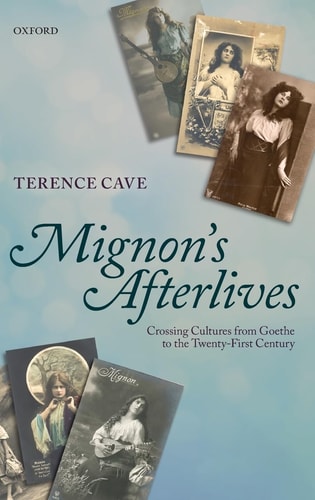
Mignon's Afterlives: Crossing Cultures from Goethe to the Twenty-First Century
0
0
As an Amazon Associate and affiliate partner, Menrva Books earns from qualifying purchases. Learn more
Author Description
By tracing the afterlives of Mignon, an apparently minor character in Goethe's novel Wilhelm Meisters Lehrjahre, Terence Cave explores a phenomenal success story in the history of literature and music, and more broadly of cultural history. Mignon steps out of the shadow of its protagonist Wilhelm and fashions a destiny of her own: she becomes the object of an obsessive interest that reached its peak in the later nineteenth century but continues to reverberate into the twenty-first century.Mignon reappears - often as a character bearing a different name but sharing an unmistakable family resemblance with her - in a wide range of different literary works from Goethe himself via the German Romantic Novel, Mme de Stael, George Sand, Nerval and Baudelaire, Walter Scott and George Eliot to Gerhart Hauptmann and Angela Carter. Her songs, set by dozens of composers from Reichardt and Beethoven to Wolf, reverberated through the drawing-rooms and concert-halls of nineteenth-century Europe. She is the heroine of the most popular French opera of the late nineteenth century, and she has featured in a number of films. She is fascinating because she is poised on the threshold between childhood and adolescence, aphasia and expressive power, words and music; she is a wanderer who has lost her home, an exile who has been abducted and abused; and the many stories in which her life is reenacted provide a litmus test for key cultural values of the nineteenth and twentieth centuries.
Menrva's Summary
THE THESIS
*This study investigates the enduring cultural impact and evolution of the character Mignon from Goethe’s Wilhelm Meisters Lehrjahre across two centuries of European art and literature.* Terence Cave, a scholar of French and comparative literature, utilizes a multidisciplinary approach to track how this singular figure transitioned from a minor character into a recurring archetype. By analyzing literary texts, musical compositions, and film adaptations, the author argues that Mignon serves as a critical barometer for shifting cultural values regarding childhood, exile, and artistic expression.
THE SCOPE MAP
What You Will Find
- A historical analysis of Mignon’s appearances in works by authors including George Sand, Walter Scott, and Angela Carter.
- An examination of musical settings by composers ranging from Beethoven to Hugo Wolf.
- A study of the transition of the character across different media, including opera and cinema.
- A thematic exploration of the liminal space between childhood and adolescence, and the intersection of aphasia and musical expression.
THE AUTHORITY PERSPECTIVE
Scholars recognize this work as a comprehensive study of character reception and the mechanics of cultural transmission. The text is noted for its academic rigor and its ability to synthesize diverse artistic mediums into a cohesive historical narrative.
Page Count:
328
Publication Date:
2011-11-01
Publisher:
Oxford University Press
ISBN-10:
0199604800
ISBN-13:
9780199604807
European
Literature
Comparative
Cultural History
Literary Criticism
Music History
Community Tags
Similar Books