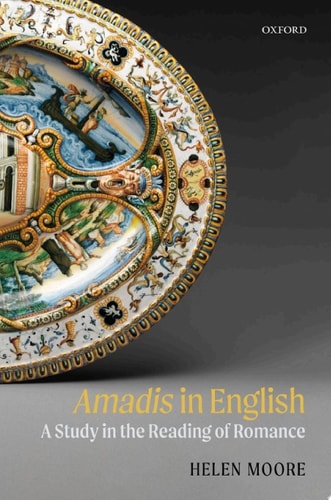
Amadis in English: A Study in the Reading of Romance
0
0
As an Amazon Associate and affiliate partner, Menrva Books earns from qualifying purchases. Learn more
Author Description
This is a book about readers: readers reading, and readers writing. They are readers of all ages and from all ages: young and old, male and female, from Europe and the Americas. The book they are reading is the Spanish chivalric romance Amadís de Gaula, known in English as Amadis de Gaule. Famous throughout the sixteenth century as the pinnacle of its fictional genre, the cultural functions of Amadis were further elaborated by the publication of Cervantes's Don Quixote in 1605, in which Amadis features as Quixote's favourite book. Amadis thereby becomes, as the philosopher Ortega y Gasset terms it, 'enclosed' within the modern novel and part of the imaginative landscape of British reader-authors such Mary Shelley, Smollett, Keats, Southey, Scott, and Thackeray. Amadis in English ranges from the sixteenth to the twentieth centuries, demonstrating through this 'biography' of a book the deep cultural, intellectual, and political connections of English, French, and Spanish literature across five centuries. Simultaneously an ambitious work of transnational literary history and a new intervention in the history of reading, this study argues that romance is historically located, culturally responsive, and uniquely flexible in the re-creative possibilities it offers readers. By revealing this hitherto unexamined reading experience connecting readers of all backgrounds, Amadis in English also offers many new insights into the politicisation of literary history; the construction and misconstruction of literary relations between England, France, and Spain; the practice and pleasures of reading fiction; and the enduring power of imagination.
Menrva's Summary
THE THESIS
This study investigates the historical reception and cultural impact of the Spanish chivalric romance Amadís de Gaula within the English-speaking world from the sixteenth to the twentieth centuries. Helen Moore, a scholar of early modern literature, utilizes a vast array of archival evidence and literary analysis to demonstrate how this specific text functioned as a bridge between diverse reader-authors. She argues that the flexibility of the romance genre allowed it to remain a central, evolving component of the Western imaginative landscape across five centuries.
THE SCOPE MAP
What You Will Find
- A longitudinal analysis of the reception of Amadís de Gaula in England, France, and Spain.
- Examination of the influence of the text on major authors including Mary Shelley, Keats, Scott, and Thackeray.
- A methodological framework for the history of reading that tracks how texts are re-interpreted over time.
- Discussion of the interplay between the original romance and its subversion in Cervantes's Don Quixote.
Scope Limits
- The study focuses primarily on the English-language reception and does not provide an exhaustive analysis of every regional translation.
- It does not attempt to provide a comprehensive literary biography of the original Spanish author, focusing instead on the 'biography' of the book as an object of consumption.
THE AUTHORITY PERSPECTIVE
Scholars recognize this work as a significant contribution to the field of transnational literary history and the history of reading. Experts frequently highlight the meticulous research and the clarity with which Moore connects disparate historical periods through the lens of a single, influential text.
Page Count:
416
Publication Date:
2020-01-01
Publisher:
OUP Oxford
ISBN-10:
0192568566
ISBN-13:
9780192568564
European
Cultural History
History of Reading
Literary Criticism
Comparative
Community Tags
Similar Books