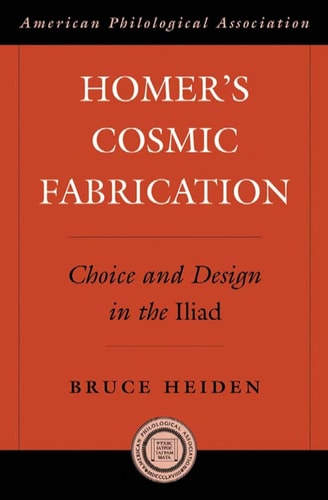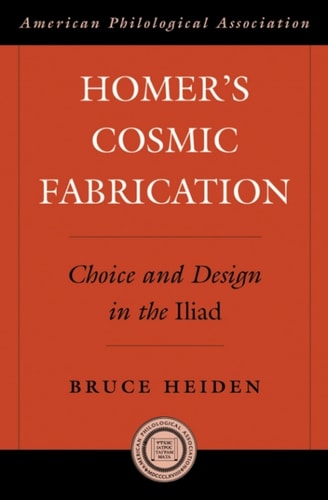
Homer's Cosmic Fabrication: Choice and Design in the Iliad
0
0
As an Amazon Associate and affiliate partner, Menrva Books earns from qualifying purchases. Learn more
Author Description
Although scholars routinely state that the Iliad is an "oral poem," since very near the time of its composition the great epic has circulated as a text stabilized in writing. Thus whether or not it is in some sense "oral poetry," the Iliad undoubtedly has features that render it quite satisfactory to readers and reading. But the question of what these features might be has been difficult for modern Homeric scholarship even to frame, much less address, within the research paradigm of "oral poetics." In Homer's Cosmic Fabrication Bruce Heiden delineates a new approach aimed at evaluating what the Iliad furnishes to readers that makes it comprehensible and engaging. His program conceptualizes the act of reading as a flexible repertoire of cognitive functions that a reader might deploy in collaboration with the poem's signs. By positing certain functions hypothetically and applying them to the poem, Heiden's experiments uncover the kind and degree of suitable "reading material" the poem provides. These analyses reveal that the trajectory of events in the Iliad manifests the central agency of one character, Zeus, and that the transmitted articulation of the epic into chapter-like "books" conforms to distinct narrative subtrajectories. The analyses also show, however, that the fixed sequence of "books" functions suitably as a design that cues attention to the major crises in the story, as well as to themes that develop its significance. The transmitted arrangement therefore furnishes an implicit cognitive map that both eases comprehension of the storyline and indicates previously unexplored pathways of interpretation. Through Homer's Cosmic Fabrication enthusiasts of the Iliad will gain enhanced understanding of the epic's poetic design and the philosophical rewards it offers to thoughtful study.
Menrva's Summary
THE THESIS
This book investigates how the structural and narrative features of the Iliad facilitate reader comprehension and engagement, challenging the traditional focus on oral poetics. Bruce Heiden, a scholar of classical literature, proposes a cognitive framework that treats the act of reading as a collaborative process between the reader and the text's signs. By applying this methodology to the epic, he argues that the poem's transmitted arrangement into books serves as a deliberate design that guides the reader's attention toward central crises and thematic development. The study posits that the Iliad functions as a sophisticated, stabilized text that provides specific cognitive pathways for interpretation.
THE SCOPE MAP
What You Will Find
- A cognitive methodology for analyzing reader interaction with ancient epic texts.
- An examination of the role of Zeus as the central agent within the narrative trajectory.
- An analysis of the Iliad's division into books as a functional design for thematic emphasis.
- A study of how the poem's structure serves as an implicit cognitive map for the reader.
THE AUTHORITY PERSPECTIVE
Scholars and classicists recognize this work as a shift away from the dominant oral-formulaic paradigm toward a text-centered analysis of Homeric structure. Readers frequently note the academic density of the prose, which is intended for those with a background in classical philology and literary theory.
Page Count:
272
Publication Date:
2008-01-01
Publisher:
Oxford University Press
ISBN-10:
0199712425
ISBN-13:
9780199712427
Epic Poetry
Homer
Literary Criticism
Ancient Greek
English & College Success
English