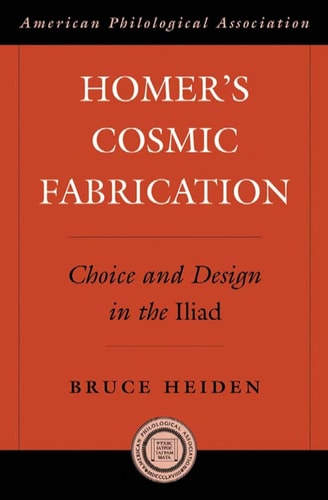
Homer's Cosmic Fabrication: Choice and Design in the Iliad
0
0
As an Amazon Associate and affiliate partner, Menrva Books earns from qualifying purchases. Learn more
Author Description
Although scholars routinely state that the Iliad is an "oral poem," since very near the time of its composition the great epic has circulated as a text stabilized in writing. Thus whether or not it is in some sense "oral poetry," the Iliad undoubtedly has features that render it quite satisfactory to readers and reading. But the question of what these features might be has been difficult for modern Homeric scholarship even to frame, much less address, within the research paradigm of "oral poetics."In Homer's Cosmic Fabrication Bruce Heiden delineates a new approach aimed at evaluating what the Iliad furnishes to readers that makes it comprehensible and engaging. His program conceptualizes the act of reading as a flexible repertoire of cognitive functions that a reader might deploy in collaboration with the poem's signs. By positing certain functions hypothetically and applying them to the poem, Heiden's experiments uncover the kind and degree of suitable "reading material" the poem provides.These analyses reveal that the trajectory of events in the Iliad manifests the central agency of one character, Zeus, and that the transmitted articulation of the epic into chapter-like "books" conforms to distinct narrative subtrajectories. The analyses also show, however, that the fixed sequence of "books" functions suitably as a design that cues attention to the major crises in the story, as well as to themes that develop its significance. The transmitted arrangement therefore furnishes an implicit cognitive map that both eases comprehension of the storyline and indicates previously unexplored pathways of interpretation. Through Homer's Cosmic Fabrication enthusiasts of the Iliad will gain enhanced understanding of the epic's poetic design and the philosophical rewards it offers to thoughtful study.
Menrva's Summary
THE THESIS
This book investigates how the Iliad functions as a coherent, readable text by analyzing the specific design elements that facilitate reader comprehension and engagement. Bruce Heiden, a scholar of classical literature, challenges the traditional focus on oral poetics by proposing a cognitive framework for interpreting the epic as a written artifact. He argues that the poem's structure, particularly the role of Zeus and the division into books, provides a deliberate cognitive map that guides the reader through complex narrative crises and thematic developments.
THE SCOPE MAP
What You Will Find
- A cognitive framework for analyzing reader interaction with epic poetry.
- An examination of the narrative agency of Zeus as a structural anchor.
- An analysis of the Iliad's division into books as a functional design element.
- Methodological experiments applying cognitive functions to classical text.
THE AUTHORITY PERSPECTIVE
Scholars and students of Homeric literature recognize this work as a significant departure from traditional oral-formulaic analysis. The text is noted for its dense, academic prose and its focus on the structural mechanics of the Iliad as a written document.
Page Count:
272
Publication Date:
2008-11-17
Publisher:
Oxford University Press
ISBN-10:
0195341074
ISBN-13:
9780195341072
Philosophy
Homer
Criticism history
Literary Criticism
Epic Poetry
Trojan War
Community Tags
Other Editions(2)
Similar Books
Reader Comments
Share Your Thoughts
No comments yet. Be the first to share your thoughts!