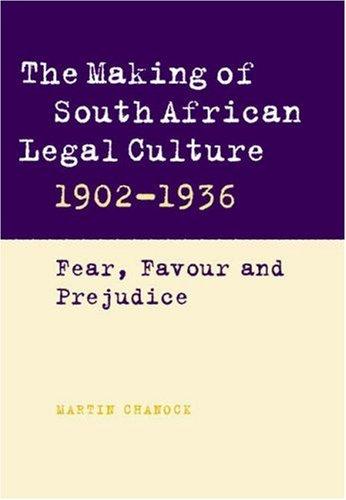
The Making of South African Legal Culture, 1902-1936
0
0
As an Amazon Associate and affiliate partner, Menrva Books earns from qualifying purchases. Learn more
Author Description
The development of the South African legal system in the early twentieth century was crucial to the establishment and maintenance of the systems which underpinned the racist state, including control of the population, the running of the economy, and the legitimisation of the regime. Martin Chanock's illuminating and definitive perspective on that development examines all areas of the law including criminal law and criminology; the Roman-Dutch law; the State's African law; and land, labour and 'rule of law' questions. His revisionist analysis of the construction of South African legal culture illustrates the larger processes of legal colonisation, while the consideration of the interaction between imported doctrine and legislative models with local contexts and approaches also provides a basis for understanding the re-fashioning of law under circumstances of post-colonialism and globalisation.--BOOK JACKET.
Menrva's Summary
THE THESIS
This book investigates the critical period of South African legal development between 1902 and 1936, a time when the legal system was instrumental in establishing and maintaining the structures of the racist state. Martin Chanock's work offers a definitive perspective on this era, scrutinizing various legal domains including criminal law, Roman-Dutch law, the state's approach to African law, and issues surrounding land, labor, and the rule of law. The analysis revises understandings of how South African legal culture was constructed, highlighting broader processes of legal colonization. It also examines the interplay between imported legal doctrines and legislative frameworks, and their adaptation to local contexts, providing insights into legal transformations in post-colonial and globalized settings.
THE SCOPE MAP
- An examination of criminal law and criminology in early 20th-century South Africa.
- Analysis of the Roman-Dutch legal tradition and its application.
- A study of the State's administration and legal framework for African populations.
- Exploration of land and labor laws and their role in social control.
- Discussion of 'rule of law' questions within the context of the time.
- A revisionist perspective on the construction of South African legal culture.
- Consideration of legal colonization and post-colonial legal adaptation.
THE AUTHORITY PERSPECTIVE
The book is recognized for its illuminating and definitive perspective on the development of the South African legal system during a pivotal period. Its revisionist analysis of legal culture construction is noted for illustrating larger processes of legal colonization. The examination of the interaction between imported legal doctrine and local contexts offers a basis for understanding legal re-fashioning in post-colonial and globalized circumstances. This work is considered essential for understanding the historical underpinnings of the South African legal framework.
Page Count:
571
Publication Date:
2001-01-01
ISBN-10:
0521791561
Non-Fiction
History
Legal History
Colonialism
Community Tags
Similar Books