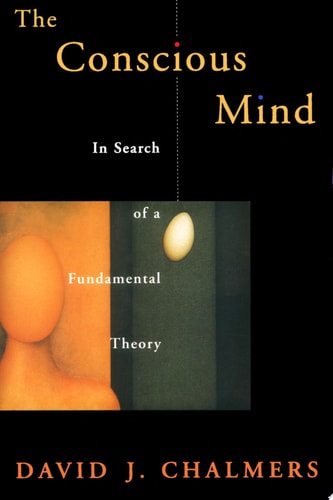
The Conscious Mind: In Search of a Fundamental Theory (Philosophy of Mind)
0
0
As an Amazon Associate and affiliate partner, Menrva Books earns from qualifying purchases. Learn more
Author Description
What is consciousness? How do physical processes in the brain give rise to the self-aware mind and to feelings as profoundly varied as love or hate, aesthetic pleasure or spiritual yearning? These questions today are among the most hotly debated issues among scientists and philosophers, and we have seen in recent years superb volumes by such eminent figures as Francis Crick, Daniel C. Dennett, Gerald Edelman, and Roger Penrose, all firing volleys in what has come to be called the consciousness wars. Now, in The Conscious Mind, philosopher David J. Chalmers offers a cogent analysis of this heated debate as he unveils a major new theory of consciousness, one that rejects the prevailing reductionist trend of science, while offering provocative insights into the relationship between mind and brain. Writing in a rigorous, thought-provoking style, the author takes us on a far-reaching tour through the philosophical ramifications of consciousness. Chalmers convincingly reveals how contemporary cognitive science and neurobiology have failed to explain how and why mental events emerge from physiological occurrences in the brain. He proposes instead that conscious experience must be understood in an entirely new light--as an irreducible entity (similar to such physical properties as time, mass, and space) that exists at a fundamental level and cannot be understood as the sum of its parts. And after suggesting some intriguing possibilities about the structure and laws of conscious experience, he details how his unique reinterpretation of the mind could be the focus of a new science. Throughout the book, Chalmers provides fascinating thought experiments that trenchantly illustrate his ideas. For example, in exploring the notion that consciousness could be experienced by machines as well as humans, Chalmers asks us to imagine a thinking brain in which neurons are slowly replaced by silicon chips that precisely duplicate their functions--as the neurons are replaced, will consciou
Menrva's Summary
THE THESIS
This book investigates the core question of how physical processes in the brain give rise to subjective conscious experience, challenging the prevailing reductionist paradigms in contemporary science. David J. Chalmers, a prominent philosopher of mind, critiques existing neurobiological and cognitive models for their failure to account for the 'hard problem' of consciousness. He argues that conscious experience is an irreducible fundamental property of the universe, akin to mass or space, and proposes a new framework that treats mental states as distinct from, yet related to, physical brain activity.
THE SCOPE MAP
What You Will Find
- A comprehensive critique of physicalist and reductionist theories of mind.
- The introduction of the 'hard problem' of consciousness as a distinct philosophical challenge.
- Thought experiments, including the 'silicon chip' replacement scenario, to test the limits of functionalism.
- A proposal for a non-reductive theory that treats consciousness as a fundamental entity.
THE AUTHORITY PERSPECTIVE
Experts and philosophers widely recognize this work as a foundational text in the modern study of consciousness, frequently citing its rigorous logical structure. Readers often note the academic density of the prose, which requires careful engagement with complex metaphysical arguments.
Page Count:
432
Publication Date:
1996-01-01
Publisher:
Oxford University Press
ISBN-10:
0199839352
ISBN-13:
9780199839353
Philosophy
Non-Fiction
Mind & Body
Consciousness
Allied Health
Dualism
Neuroscience
Medical
Community Tags
Similar Books