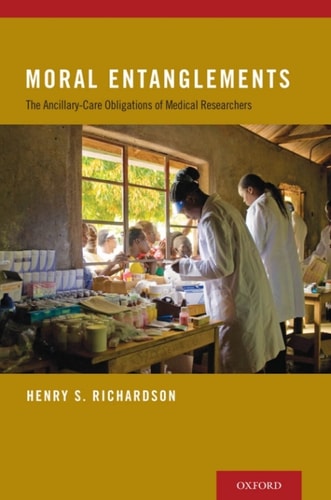
Moral Entanglements: The Ancillary-Care Obligations of Medical Researchers
0
0
As an Amazon Associate and affiliate partner, Menrva Books earns from qualifying purchases. Learn more
Author Description
The philosopher Henry Richardson's short book is a defense of a position on a neglected topic in medical research ethics. Clinical research ethics has been a longstanding area of study, dating back to the aftermath of the Nazi death-camp doctors and the Tuskegee syphilis study. Most ethical regulations and institutions (such as Institutiional Review Boards) have developed in response to those past abuses, including the stress on obtaining informed consent from the subject. Richardson points out that that these ethical regulations do not address one of the key dilemmas faced by medical researchers -- whether or not they have obligations towards subjects who need care not directly related to the purpose of the study, termed "ancillary care obligations." Does a researcher testing an HIV vaccine in Africa have an obligation to provide anti-retrovirals to those who become HIV positive during the trial? Should a researcher studying a volunteer's brain scan, who sees a possible tumor, do more than simply refer him or her to a specialist? While most would agree that some special obligation does exist in these cases, what is the basis of this obligation, and what are its limits? Richardson's analysis of those key questions and the development of his own position are at the heart of this book, which will appeal to bioethicists studying research ethics, to policy makers, and to political and moral philosophers interested in the obligations of beneficence, one of the key issues in moral theory." 'Philosophy recovers itself,' wrote John Dewey, 'when it ceases to be a device for dealing with the problems of philosophers and becomes a method, cultivated by philosophers, for dealing with the problems of men.' Henry Richardson confronts a problem in the ethics of medical research that is often (as his many real-life examples show) a matter of life and death. The problem is unexplored and quite difficult: Richardson finds he must craft new theory to deal with it. The theory he create
Menrva's Summary
THE THESIS
This book investigates the moral obligations of medical researchers to provide ancillary care to study participants for health issues that fall outside the specific scope of the clinical trial. Henry S. Richardson, a philosopher specializing in ethics, addresses a significant gap in current research regulations, which prioritize informed consent but remain silent on the researcher's duty of care. By examining real-world scenarios, such as HIV vaccine trials in developing nations or incidental findings in diagnostic imaging, Richardson constructs a theoretical framework to define the basis and limits of these beneficence-based obligations.
THE SCOPE MAP
What You Will Find
- Analysis of the moral foundations of beneficence in clinical research settings.
- Theoretical framework for identifying when a researcher's duty extends beyond the study protocol.
- Case studies involving HIV vaccine trials and incidental medical findings.
- Evaluation of existing Institutional Review Board regulations and their limitations.
THE AUTHORITY PERSPECTIVE
Experts in bioethics and moral philosophy recognize this work as a significant contribution to a previously neglected area of research ethics. Readers frequently note the clarity of the author's philosophical arguments and the practical relevance of his proposed framework for policy makers and clinical investigators.
Page Count:
272
Publication Date:
2012-01-01
Publisher:
Oxford University Press
ISBN-10:
0199874840
ISBN-13:
9780199874842
Non-Fiction
Philosophy
Medical
Research Ethics
Medical Ethics
Bioethics
Medicine
Allied Health
Community Tags
Similar Books