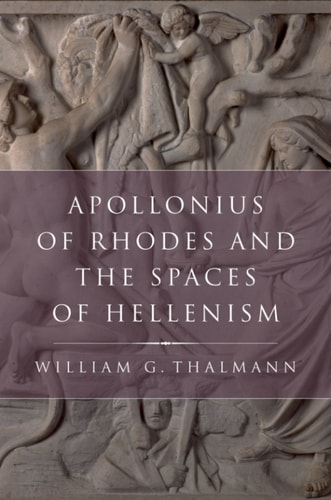
Apollonius of Rhodes and the Spaces of Hellenism
0
0
As an Amazon Associate and affiliate partner, Menrva Books earns from qualifying purchases. Learn more
Author Description
Although Apollonius of Rhodes' extraordinary epic poem on the Argonauts' quest for the Golden Fleece has begun to get the attention it deserves, it still is not well known to many readers and scholars. This book explores the poem's relation to the conditions of its writing in third century BCE Alexandria, where a multicultural environment transformed the Greeks' understanding of themselves and the world. Apollonius uses the resources of the imagination - the myth of the Argonauts' voyage and their encounters with other peoples - to probe the expanded possibilities and the anxieties opened up when definitions of Hellenism and boundaries between Greeks and others were exposed to question. Central to this concern with definitions is the poem's representation of space. Thalmann uses spatial theories from cultural geography and anthropology to argue that the Argo's itinerary defines space from a Greek perspective that is at the same time qualified. Its limits are exposed, and the signs with which the Argonauts mark space by their passage preserve the stories of their complex interactions with non-Greeks. The book closely considers many episodes in the narrative with regard to the Argonauts' redefinition of space and the implications of their actions for the Greeks' situation in Egypt, and it ends by considering Alexandria itself as a space that accommodated both Greek and Egyptian cultures.
Menrva's Summary
THE THESIS
This book investigates how Apollonius of Rhodes utilized the Argonautic myth to navigate and redefine the cultural boundaries of Hellenism within the multicultural environment of third-century BCE Alexandria. William G. Thalmann, a scholar of classical literature, employs spatial theories derived from cultural geography and anthropology to analyze the Argonautica. He argues that the poem serves as a complex reflection of the anxieties and possibilities inherent in the Greek experience of living among non-Greek populations in Egypt. By examining the itinerary of the Argo, the author demonstrates how the text constructs a Greek perspective that simultaneously acknowledges its own limitations and the necessity of cross-cultural interaction.
THE SCOPE MAP
What You Will Find
- Analysis of the Argonautica within the historical context of Ptolemaic Alexandria.
- Application of cultural geography and spatial theory to ancient epic poetry.
- Examination of the Argonauts' encounters with non-Greek peoples as a metaphor for cultural identity.
- A concluding study on Alexandria as a hybrid space accommodating both Greek and Egyptian traditions.
THE AUTHORITY PERSPECTIVE
Scholars frequently cite this work as a significant contribution to the study of Hellenistic literature and the intersection of geography and identity. It is regarded as a sophisticated text that provides essential insights for those interested in the cultural politics of the ancient Mediterranean world.
Page Count:
288
Publication Date:
2011-01-01
Publisher:
Oxford University Press
ISBN-10:
0199875715
ISBN-13:
9780199875719
History
Anthropology
English & College Success
Greek poetry
Criticism history
Literary Criticism
Ancient History
English
Community Tags
Other Editions(2)

Similar Books