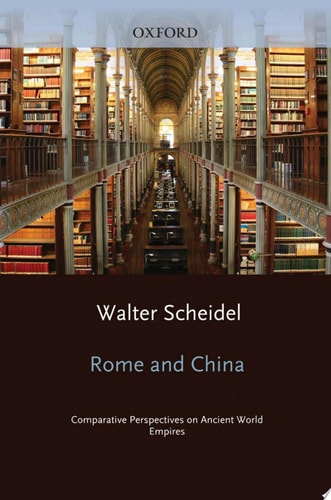
Rome and China: Comparative Perspectives on Ancient World Empires
0
0
As an Amazon Associate and affiliate partner, Menrva Books earns from qualifying purchases. Learn more
Author Description
Transcending ethnic, linguistic, and religious boundaries, early empires shaped thousands of years of world history. Yet despite the global prominence of empire, individual cases are often studied in isolation. This series seeks to change the terms of the debate by promoting cross-cultural, comparative, and transdisciplinary perspectives on imperial state formation prior to the European colonial expansion.Two thousand years ago, up to one-half of the human species was contained within two political systems, the Roman empire in western Eurasia (centered on the Mediterranean Sea) and the Han empire in eastern Eurasia (centered on the great North China Plain). Both empires were broadly comparable in terms of size and population, and even largely coextensive in chronological terms (221 BCE to 220 CE for the Qin/Han empire, c. 200 BCE to 395 CE for the unified Roman empire). At the most basic level of resolution, the circumstances of their creation are not very different. In the East, the Shang and Western Zhou periods created a shared cultural framework for the Warring States, with the gradual consolidation of numerous small polities into a handful of large kingdoms which were finally united by the westernmost marcher state of Qin. In the Mediterranean, we can observe comparable political fragmentation and gradual expansion of a unifying civilization, Greek in this case, followed by the gradual formation of a handful of major warring states (the Hellenistic kingdoms in the east, Rome-Italy, Syracuse and Carthage in the west), and likewise eventual unification by the westernmost marcher state, the Roman-led Italian confederation. Subsequent destabilization occurred again in strikingly similar ways: both empires came to be divided into two halves, one that contained the original core but was more exposed to the main barbarian periphery (the west in the Roman case, the north in China), and a traditionalist half in the east (Rome) and south (China).These processes of initia
Menrva's Summary
THE THESIS
This work investigates the structural and historical parallels between the Roman and Han empires to determine why these two distinct political systems developed along such remarkably similar trajectories. Walter Scheidel, a prominent historian of the ancient world, utilizes a comparative framework to analyze how these two massive empires, which together encompassed half of the human population two millennia ago, navigated state formation, expansion, and eventual fragmentation. By synthesizing archaeological data, political theory, and historical records, the author argues that the convergence of their developmental patterns suggests underlying systemic pressures common to large-scale imperial entities.
THE SCOPE MAP
What You Will Find
- Comparative analysis of the Roman and Han imperial state formation processes.
- Examination of the geopolitical factors leading to the unification of fragmented territories.
- Historical data regarding population density, administrative structures, and military expansion.
- Theoretical frameworks for understanding the collapse and division of ancient empires.
THE AUTHORITY PERSPECTIVE
Scholars and historians frequently cite this text as a foundational contribution to the field of comparative imperial studies. Readers often note the academic density of the prose, which provides a rigorous, evidence-based approach to understanding the structural mechanics of ancient world powers.
Page Count:
256
Publication Date:
2009-01-01
Publisher:
Oxford University Press
ISBN-10:
0199887527
ISBN-13:
9780199887521
History
Ancient History
Asian History
History - Ancient
History
Sociology
Comparative History
Community Tags
Other Editions(2)
Similar Books















Reader Comments
Share Your Thoughts
No comments yet. Be the first to share your thoughts!