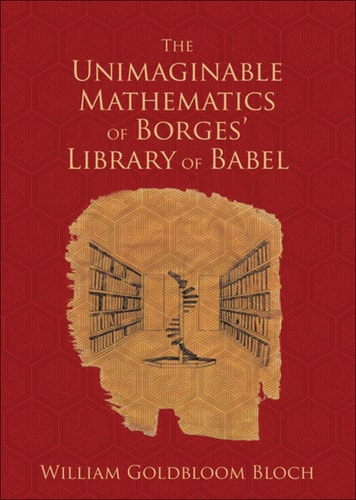
The Unimaginable Mathematics of Borges' Library of Babel
0
0
As an Amazon Associate and affiliate partner, Menrva Books earns from qualifying purchases. Learn more
Author Description
"The Library of Babel" is arguably Jorge Luis Borges' best known story--memorialized along with Borges on an Argentine postage stamp. Now, in The Unimaginable Mathematics of Borges' Library of Babel, William Goldbloom Bloch takes readers on a fascinating tour of the mathematical ideas hidden within one of the classic works of modern literature. Written in the vein of Douglas R. Hofstadter's Pulitzer Prize-winning Gödel, Escher, Bach, this original and imaginative book sheds light on one of Borges' most complex, richly layered works. Bloch begins each chapter with a mathematical idea--combinatorics, topology, geometry, information theory--followed by examples and illustrations that put flesh on the theoretical bones. In this way, he provides many fascinating insights into Borges' Library. He explains, for instance, a straightforward way to calculate how many books are in the Library--an easily notated but literally unimaginable number--and also shows that, if each book were the size of a grain of sand, the entire universe could only hold a fraction of the books in the Library. Indeed, if each book were the size of a proton, our universe would still not be big enough to hold anywhere near all the books. Given Borges' well-known affection for mathematics, this exploration of the story through the eyes of a humanistic mathematician makes a unique and important contribution to the body of Borgesian criticism. Bloch not only illuminates one of the great short stories of modern literature but also exposes the reader--including those more inclined to the literary world--to many intriguing and entrancing mathematical ideas.
Menrva's Summary
THE THESIS
This book investigates the mathematical foundations and logical structures embedded within Jorge Luis Borges' short story, 'The Library of Babel.' William Goldbloom Bloch, a mathematician with a deep appreciation for literature, utilizes the story as a framework to explain complex concepts such as combinatorics, topology, and information theory. By bridging the gap between abstract mathematical theory and literary analysis, the author demonstrates how Borges' fictional construct serves as a rigorous model for exploring the limits of the physical and mathematical universe.
THE SCOPE MAP
What You Will Find
- Mathematical principles including combinatorics, topology, geometry, and information theory.
- Calculations regarding the total number of volumes contained within the infinite library.
- Comparative analysis of the library's physical scale relative to the known universe.
- Interpretations of Borgesian themes through the lens of humanistic mathematics.
THE AUTHORITY PERSPECTIVE
Experts and readers alike note that this text successfully bridges the divide between literary criticism and hard science. It is frequently cited as a accessible entry point for those interested in the intersection of mathematical theory and classic literature.
Page Count:
212
Publication Date:
2008-01-01
Publisher:
Oxford University Press
ISBN-10:
0199887306
ISBN-13:
9780199887309
Philosophy
Non-Fiction
Science
Mathematics Statistics
Mathematics
English
Mathematics - General
Literary Criticism
English & College Success
Earth Sciences
Community Tags
Other Editions(3)
Similar Books









Reader Comments
Share Your Thoughts
No comments yet. Be the first to share your thoughts!