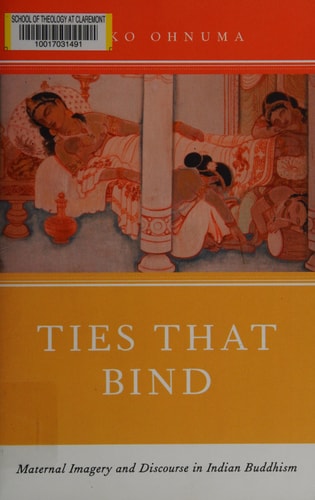
Ties That Bind: Maternal Imagery and Discourse in Indian Buddhism
0
0
As an Amazon Associate and affiliate partner, Menrva Books earns from qualifying purchases. Learn more
Author Description
Reiko Ohnuma offers a wide-ranging exploration of the complex role of maternal imagery and discourse in pre-modern South Asian Buddhism. Motherhood was sometimes extolled as the most appropriate symbol for buddhahood itself, and sometimes denigrated as the most paradigmatic manifestation of attachment and suffering. In Buddhist literature, feelings of love and gratitude for the mother's nurturance frequently mingle with submerged feelings of hostility and resentment for the unbreakable obligations thus created, and positive images of self-sacrificing mothers are counterbalanced by horrific depictions of mothers who kill and devour. Institutionally, the formal definition of the Buddhist renunciant as one who has severed all familial ties seems to co-exist uneasily with an abundance of historical evidence demonstrating monks' and nuns' continuing concern for their mothers, as well as other familial entanglements. Ohnuma's study provides critical insight into Buddhist depictions of maternal love and grief, the role of the Buddha's own mothers, Maya and Mahaprajapata, the use of pregnancy and gestation as metaphors for the attainment of enlightenment, the use of breastfeeding as a metaphor for the compassionate deeds of buddhas and bodhisattvas, and the relationship between Buddhism and motherhood as it actually existed in day-to-day life.
Menrva's Summary
THE THESIS
This work investigates the paradoxical role of maternal imagery and discourse within pre-modern South Asian Buddhist traditions. Reiko Ohnuma, a scholar of Buddhist studies, examines the tension between the idealization of motherhood as a symbol of compassion and the denigration of maternal attachment as a source of suffering. By analyzing a wide array of canonical texts and historical evidence, the author argues that the Buddhist tradition maintains a complex, often contradictory relationship with the figure of the mother, reflecting both the desire for renunciation and the reality of human familial bonds.
THE SCOPE MAP
What You Will Find
- Analysis of maternal metaphors including pregnancy, gestation, and breastfeeding in relation to enlightenment.
- Examination of the lives and roles of the Buddha's mothers, Maya and Mahaprajapata.
- Exploration of the institutional conflict between the monastic ideal of severing ties and the reality of familial concern.
- Discussion of the dichotomy between self-sacrificing maternal figures and horrific depictions of mothers in Buddhist literature.
THE AUTHORITY PERSPECTIVE
Scholars and students of religious studies frequently cite this text as a foundational analysis of gender and family dynamics in Buddhist history. Experts highlight the author's ability to synthesize dense textual evidence with broader sociological implications, making it a standard reference for understanding the intersection of monasticism and domestic life.
Page Count:
288
Publication Date:
2012-07-01
Publisher:
Oxford University Press
ISBN-10:
0199915652
ISBN-13:
9780199915651
History
Religion
Buddhism
Buddhism india
Sociology
Gender Studies
Community Tags
Similar Books