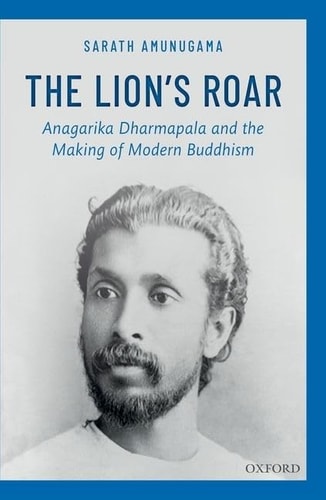
The Lion's Roar: Anagarika Dharmapala and the Making of Modern Buddhism
0
0
As an Amazon Associate and affiliate partner, Menrva Books earns from qualifying purchases. Learn more
Author Description
Anagarika Dharmapala (1864-1933) was a Srilankan Buddhist reformer and national activist and ranks high among makers of modern Buddhism. Born into an affluent Sinhala merchant family, he was a youthful convert to Theosophy. The Theosophical movement that originated in Newyork in late 19th century became an important catalyst of the Hindu and Buddhist revival. Dharmapala attended the world Parliament of Religions held in Chicago in 1893 as a Buddhist delegate. Dharmapala's 'struggle' for Buddhism in India led to a transformation of nationalism in his homeland.He castigated the British colonial administration, its local lackeys for their lack of concern and his own people for their indolence and backwardness.He was a pioneer in industrial training for the youth in Sri Lanka. In India, where he spent the greater part of his life, his main and lifelong struggle was for re-establishing Buddhist management of Buddhist sacred places particularly the MAHABODHI, the reputed location of Buddha's enlightnment, which were under Hindu control. In this endeavour he interacted closely with Indian leaders like Gandhi and Nehru. His close links with particularly the Bengali intelligentsia, the 'Bhadralok', forms an intresting part of the story. Apart from this he took a great interest in the propagation of the word of the Buddha throughout the world His missionary activities encompassed the Western world as well as countries like Japan. An important aspect of this work was the promotion of Buddhist scholarship. In the twilight years of his life he had himself ordained as a Buddhist monk in India.
Menrva's Summary
THE THESIS
This work investigates the life and ideological contributions of Anagarika Dharmapala, a central figure in the revival of Buddhism and the development of modern Sri Lankan nationalism. Dr. Sarath Amunugama utilizes historical records and biographical analysis to examine how Dharmapala’s interactions with the Theosophical movement, Indian political leaders, and the Bengali intelligentsia shaped his reformist agenda. The text argues that Dharmapala’s efforts to reclaim sacred Buddhist sites in India were inextricably linked to his broader critique of colonial administration and his advocacy for social and industrial modernization in his homeland.
THE SCOPE MAP
What You Will Find
- Historical analysis of the Buddhist revival movement in the late 19th and early 20th centuries.
- Examination of the complex relationship between Dharmapala and Indian political figures such as Gandhi and Nehru.
- Documentation of the struggle to transfer management of the Mahabodhi temple from Hindu to Buddhist control.
- Insights into the influence of the Theosophical movement on Asian religious reform.
THE AUTHORITY PERSPECTIVE
Experts recognize this biography as a comprehensive study of a pivotal figure in South Asian religious history. Readers frequently note the academic rigor and the detailed contextualization of Dharmapala’s life within the broader framework of colonial-era politics.
Page Count:
648
Publication Date:
2019-11-26
Publisher:
Oxford University Press
ISBN-10:
0199489068
ISBN-13:
9780199489060
Religion
History
Biography
Colonialism
Sri Lanka
Buddhism
Buddhism india
Community Tags
Similar Books