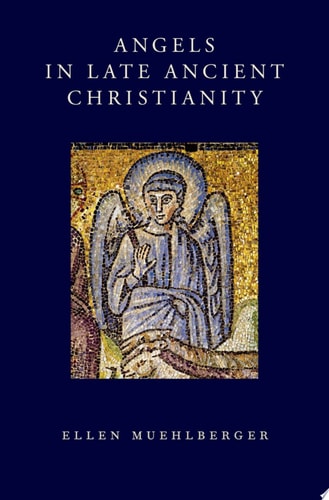
Angels in Late Ancient Christianity
1
0
As an Amazon Associate and affiliate partner, Menrva Books earns from qualifying purchases. Learn more
Author Description
Ellen Muehlberger explores the diverse and inventive ideas Christians held about angels in late antiquity. During the fourth and fifth centuries, Christians began experimenting with new modes of piety, adapting longstanding forms of public authority to Christian leadership and advancing novel ways of cultivating body and mind to further the progress of individual Christians. Muehlberger argues that in practicing these new modes of piety, Christians developed new ways of thinking about angels.The book begins with a detailed examination of the two most popular discourses about angels that developed in late antiquity. In the first, delineated by Christians cultivating certain kinds of ascetic practices, angels were one type of being among many in a shifting universe, and their primary purpose was to guard and to guide Christians. In the other, articulated by urban Christian leaders in contest with one another, angels were morally stable characters described in the emerging canon of Scripture, available to enable readers to render Scripture coherent with emerging theological positions. Muehlberger goes on to show how these two discourses did not remain isolated in separate spheres of cultivation and contestation, but influenced one another and the wider Christian culture. She offers in-depth analysis of popular biographies written in late antiquity, of the community standards of emerging monastic communities, and of the training programs developed to prepare Christians to participate in ritual, demonstrating that new ideas about angels shaped and directed the formation of the definitive institutions of late antiquity.Angels in Late Ancient Christianity is a meticulous and thorough study of early Christian ideas about angels, but it also offers a different perspective on late ancient Christian history, arguing that angels were central rather than peripheral to the emergence of Christian institutions and Christian culture in late antiquity.
Menrva's Summary
THE THESIS
How did the conceptualization of angels influence the development of institutional Christianity during the fourth and fifth centuries? Ellen Muehlberger, a scholar of early Christian history, utilizes primary source texts—including biographies, monastic rules, and training manuals—to argue that angelic discourse was not merely peripheral but foundational to the formation of Christian culture. She posits that as Christians adopted new modes of piety and leadership, their evolving understanding of angels provided a framework for both individual spiritual progress and the stabilization of ecclesiastical authority.
THE SCOPE MAP
What You Will Find
- Analysis of fourth and fifth-century Christian ascetic practices and monastic community standards.
- Examination of how angels functioned as moral anchors in the interpretation of emerging biblical canons.
- Comparison of two primary angelic discourses: the guardian-guide model and the theological-coherence model.
- Investigation into the intersection of ritual training programs and the institutionalization of Christian belief.
THE AUTHORITY PERSPECTIVE
Scholars recognize this work as a significant contribution to the study of late ancient religious thought, particularly for its focus on the intersection of piety and institutional development. Readers frequently note the academic density of the prose and the meticulous nature of Muehlberger's primary source analysis.
Page Count:
296
Publication Date:
2013-03-07
Publisher:
Oxford University Press
ISBN-10:
0199931933
ISBN-13:
9780199931934
History
Religion
Theology
Ancient History
Christianity
Angels
Community Tags
Other Editions(2)
Similar Books















Reader Comments
Share Your Thoughts
No comments yet. Be the first to share your thoughts!