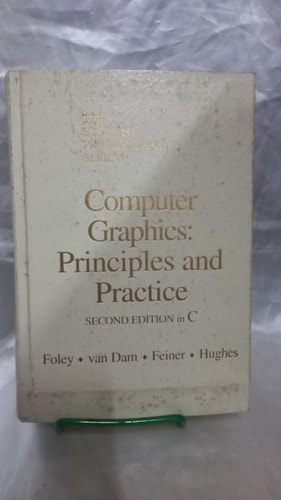
Computer Graphics
0
0
As an Amazon Associate and affiliate partner, Menrva Books earns from qualifying purchases. Learn more
Author Description
This book adopts a conceptual approach to computer graphics, with emphasis on mathematical concepts and their applications. It introduces an abstract paradigm that relates the mathematical concepts with computer graphic techniques and implementation methods. This model is intended to help the reader understand the mathematical concepts and their practical use. However, mathematical complexity has not been allowed to dominate. The haul mark of the book is its profuse solved examples which aid in the understanding of mathematical concepts. The text is supplemented with introduction to various graphics standards, animation, multimedia techniques and fractals. These topics are of immense use in each of the three visual disciplines: modeling transformations, projections and multi-view geometry for computer vision. Geometry of lines, vectors and planes is essential for any geometric computation problem, light and illumination for image-based rendering, and hidden surface removal. Almost every chapter has the working source code to illustrate the concepts, which could be written and used as small programs for better understanding of the topics. A concise appendix of open source OpenGL is also included to showcase programming concepts of computer graphics and visualization. The text is completely platform-independent and the only prerequisite is the knowledge of coordinate geometry and basic algebra. It will be useful both as a text and reference, thus it can easily be used by novices and experienced practitioners alike.
Menrva's Summary
THE THESIS
This book investigates the fundamental mathematical concepts underpinning computer graphics and their practical application. The author, Neeta Nain, presents an abstract model that bridges mathematical theory with computer graphic techniques and implementation. While emphasizing mathematical rigor, the text avoids overwhelming complexity, instead focusing on clarity through numerous solved examples. The book also incorporates discussions on graphics standards, animation, multimedia, and fractals, highlighting their relevance in visual disciplines like computer vision and modeling.
THE SCOPE MAP
- Conceptual approach to computer graphics with a focus on mathematical concepts and applications.
- Abstract paradigm relating mathematical concepts to computer graphic techniques and implementation.
- Profuse solved examples to aid understanding of mathematical concepts.
- Introduction to graphics standards, animation, multimedia techniques, and fractals.
- Coverage of geometry of lines, vectors, and planes for geometric computation.
- Discussion of light, illumination, and image-based rendering.
- Explanation of hidden surface removal techniques.
- Working source code examples in most chapters to illustrate concepts.
- Concise appendix on open source OpenGL for programming concepts.
THE AUTHORITY PERSPECTIVE
The book is structured to be useful for both novices and experienced practitioners, serving as both a text and a reference. Its platform-independent nature and minimal prerequisites, requiring only knowledge of coordinate geometry and basic algebra, make it accessible. The inclusion of source code and a focus on practical application alongside theoretical concepts suggests a pedagogical approach aimed at deep understanding.
Page Count:
470
Publication Date:
1900-01-01
Publisher:
Vikas Publishing House
ISBN-10:
9325972611
ISBN-13:
9789325972612
Science
Non-Fiction
Visualization
Mathematics
Programming
Computer Science
Computer graphics
Community Tags
Similar Books