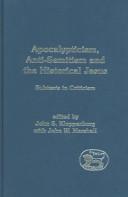
Apocalypticism, Anti-semitism and the Historical Jesus
0
0
As an Amazon Associate and affiliate partner, Menrva Books earns from qualifying purchases. Learn more
Author Description
Virtually all scholars agree that apocalyptic and millenarianism formed at least part of the matrix of the culture in first-century Jewish Palestine, but there is a sharp disagreement concerning the extent to which Jesus shared apocalyptic and millenarian beliefs. Although there has been a great deal written defending or opposing an 'apocalyptic Jesus', almost nothing has been said on the questions of what, from the standpoint of modern historiography of Jesus, is at stake in the issue of whether or not he was an apocalypticist or a millenarian prophet, and what is at stake in arguing that his alleged apocalypticism is a central and defining characteristic, rather than an incidental feature. Much has been said on the kind of Jew Jesus was, but almost nothing is said on why the category of Judaism has become so central to historical Jesus debates. These questions have less to do with the quantity and character of the available ancient evidence than they do with the ways in which the modern critic assembles evidence into a coherent picture, and the ideological and theological subtexts of historical Jesus scholarship. Scholars of Christian origins have been rather slow to inquire into the ideological location of their own work as scholars, but it is this question that is crucial in achieving a critical self-awareness of the larger entailments of historical scholarship on Jesus and the early Jesus movement. This volume begins the inquiry into the ideological location of modern historical Jesus scholarship. JSHJ, JSNTS275
Menrva's Summary
THE THESIS
This book investigates the ideological underpinnings of historical Jesus scholarship, particularly concerning the debate over his apocalyptic beliefs. The author examines the scholarly consensus on the apocalyptic nature of first-century Jewish Palestine and the significant disagreement regarding Jesus's own adherence to these beliefs. It questions the stakes involved in defining Jesus as an apocalyptic figure and explores why the category of 'Judaism' has become so central to these historical debates, arguing that these issues are less about the quantity of evidence and more about the critic's assembly of that evidence and the ideological subtexts of the scholarship itself.
THE SCOPE MAP
- Analysis of the scholarly debate on Jesus's apocalyptic and millenarian beliefs.
- Examination of the historiographical significance of defining Jesus as an apocalypticist.
- Inquiry into the centrality of the 'Judaism' category in historical Jesus scholarship.
- Exploration of how modern critics assemble evidence and the role of ideological subtexts.
- Discussion on the ideological location of Christian origins scholarship.
- Begins an inquiry into the larger entailments of historical scholarship on Jesus and the early Jesus movement.
THE AUTHORITY PERSPECTIVE
This scholarly work delves into the complex historiography surrounding the historical Jesus, specifically focusing on the persistent debate about his apocalyptic beliefs. It critically examines how scholars construct their arguments and the underlying ideological frameworks that shape interpretations of Jesus and his context within first-century Judaism. The book is positioned as a foundational text for understanding the self-awareness required in the critical study of Christian origins. Its approach suggests a dense, analytical text aimed at academics and advanced students in religious studies and history.
Page Count:
141
Publication Date:
2005-01-01
ISBN-10:
0567084280
Religion
History
Non-Fiction
Judaism
Theology
Community Tags
Similar Books