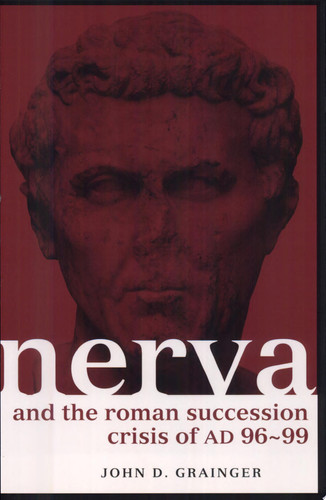
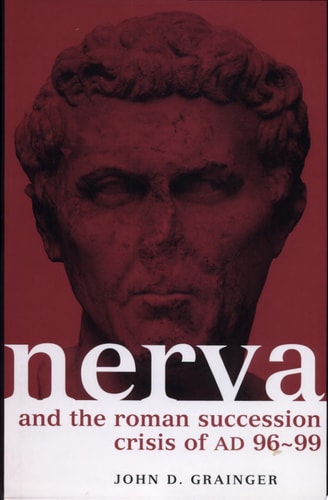
Nerva and the Roman Succession Crisis of AD 96-99
0
0
As an Amazon Associate and affiliate partner, Menrva Books earns from qualifying purchases. Learn more
Author Description
The imperial succession at Rome was notoriously uncertain, and where possible hereditary succession was preferred.John Grainger's detailed study looks at aperiod of intrigue and conspiracy. He explores how, why and by whom Domitian was killed, the rule of Nerva, chosen to succeed him, and finally Nerva's own choice of successor, Trajan, who became a strong and respected emperor against the odds.Perhaps most significantly Grainger investigates the effects of this dynastic uncertainty both inside and outside the ruling group in Rome, asking why civil war did not occur in this time of political upheaval.The last time a dynasty had failed, in AD 68, a damaging military conflict had resulted; at the next failure in AD 192, another war broke out; by the third century civil war was institutionalized, and was one of the main reasons for the eventual downfall of the entire imperial structure. Grainger argues that though AD 96-98 stands out as the civil war that did not happen, it was a perilously close-run thing.
Menrva's Summary
THE THESIS
This work investigates the critical political transition in Rome between AD 96 and 99, specifically questioning how the empire avoided civil war following the assassination of Domitian. John D. Grainger, a specialist in Roman history, utilizes primary source analysis and political theory to examine the precarious nature of imperial succession. He argues that the transition from Domitian to Nerva, and subsequently to Trajan, represents a unique moment of stability in an era otherwise defined by violent power struggles. By comparing this period to the crises of AD 68 and AD 192, the author highlights the fragile mechanisms that prevented total systemic collapse.
THE SCOPE MAP
What You Will Find
- Detailed analysis of the assassination of Domitian and the subsequent political maneuvering in the Roman Senate.
- Examination of the administrative and military challenges faced by Nerva during his brief reign.
- Comparative study of Roman succession crises across the first, second, and third centuries.
- Evaluation of the factors that prevented institutionalized civil war during the transition to Trajan.
THE AUTHORITY PERSPECTIVE
Historians and scholars of the Roman Empire frequently cite this work for its focused examination of a pivotal, yet often overlooked, period of political instability. Readers note the academic rigor of the text, which provides a clear, evidence-based argument regarding the survival of the imperial structure during the late first century.
Page Count:
192
Publication Date:
2003-01-01
Publisher:
Taylor & Francis Group
ISBN-10:
0203218078
ISBN-13:
9780203218075
History
Biography
Rome
Political History
Emperors
Ancient History
Roman History
Community Tags
Other Editions(3)
Similar Books