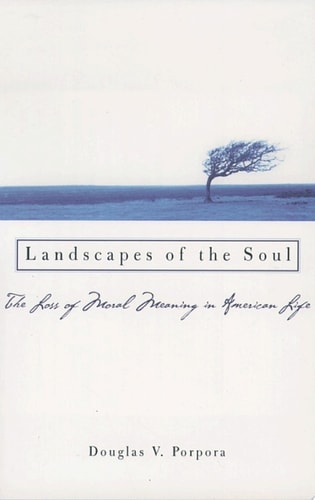
Landscapes of the Soul: The Loss of Moral Meaning in American Life
0
0
As an Amazon Associate and affiliate partner, Menrva Books earns from qualifying purchases. Learn more
Author Description
Do you believe in God? Nine out of ten Americans unhesitatingly answer yes. But for Douglas Porpora, the real questions begin where pollsters leave off. What, he asks, does religious belief actually mean in our lives? Does it shape our identities and our actions? Or, despite our professions of faith, are we morally adrift? Landscapes of the Soul paints a disturbing picture of American spiritual life. In his search for answers to his questions, Porpora interviewed clerks and executives, Jews, evangelical Christians, Buddhists, Taoists, and even followers of Bhagwan Sri Rajneesh. He asked them about God, and about what they saw as their own place in the universe. What he found was a widespread inability to articulate any grand meaning of life. We lack heroes to inspire us. We lack a sense of calling, of transcendent purpose in our existence. Many of us seem incapable of caring deeply about the suffering of others. Our society is permeated with moral indifference. Yes, we are a believing people, but God is often a distant abstraction and rarely an emotional presence in our lives. Only such an emotional connection, Porpora argues, can be the basis of a genuine moral vision. Our emotional estrangement from God and the sacred keeps us from caring about social justice, keeps us from wanting to change the world, keeps us enclosed in our own private worlds. Landscapes of the Soul is a passionate call to broaden our spiritual and moral horizons, to raise our eyes to the greater reality that unites us all.
Menrva's Summary
THE THESIS
This book investigates the disconnect between high rates of religious belief in America and the apparent absence of a coherent, motivating moral framework in daily life. Douglas V. Porpora, a sociologist, utilizes qualitative interview data from a diverse cross-section of the American public to examine how individuals conceptualize their relationship with the divine. He argues that while religious affiliation remains high, God has become a distant abstraction, resulting in a pervasive moral indifference and a lack of transcendent purpose in modern society.
THE SCOPE MAP
What You Will Find
- Qualitative interview data from a diverse demographic of American religious practitioners.
- Analysis of the intersection between personal identity and spiritual belief.
- Examination of the relationship between emotional connection to the sacred and social justice.
Scope Limits
- The study does not provide a comprehensive statistical survey of all American religious denominations.
- The text does not offer a prescriptive theological guide or a specific religious curriculum.
THE AUTHORITY PERSPECTIVE
Sociologists and cultural critics often cite this work for its focus on the gap between public profession of faith and private moral practice. Readers frequently note the accessible yet probing nature of the interviews, which highlight the challenges of maintaining a sense of collective purpose in a highly individualistic society.
Page Count:
365
Publication Date:
2003-01-01
Publisher:
Oxford University Press
ISBN-10:
0190290803
ISBN-13:
9780190290801
Religion
Philosophy
Social Commentary
United States
Ethics
Special Topics
Sociology