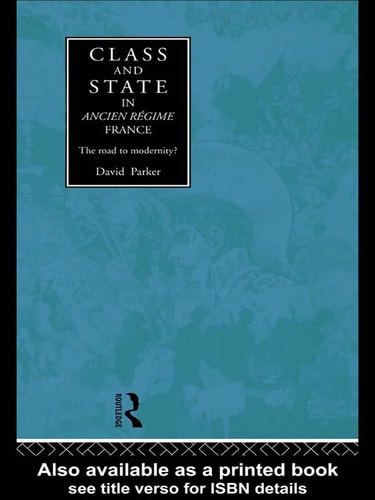
Class and State in Ancien Regime France
0
0
As an Amazon Associate and affiliate partner, Menrva Books earns from qualifying purchases. Learn more
Author Description
Class and State in Early Modern France explores the economic, social, ideological and political foundations of French Absolutism. David Parker's challenging interpretation presents French Absolutism as a remarkably successful attempt to preserve the political and ideological structures of the traditional order. This reassessment runs contrary to much revisionist historiography, rejecting the widespread tendency to treat French Absolutism either as an instrument of capitalism or political modernisation. It also discusses a number of contentious issues such as the agrarian foundations of capitalism, the relationship between class and status, as well as the structure and ideology of the absolute state itself. It will be of interest to early modern historians of France, Britain and Europe.
Menrva's Summary
THE THESIS
This work investigates the core question of whether French Absolutism functioned as a catalyst for modernization or as a mechanism to preserve traditional social and political hierarchies. David Parker, a scholar of early modern history, utilizes a rigorous analytical framework to challenge prevailing revisionist historiography. By examining the interplay between economic foundations and political ideology, he argues that the absolute state was a deliberate effort to maintain the status quo rather than an engine for capitalist development.
THE SCOPE MAP
What You Will Find
- Analysis of the agrarian foundations of capitalism in early modern France
- Examination of the relationship between class structures and social status
- Critique of revisionist historiography regarding the nature of the absolute state
- Investigation into the ideological and political pillars of French Absolutism
THE AUTHORITY PERSPECTIVE
Historians frequently cite this text as a significant contribution to the debate surrounding the nature of the Ancien Regime. The prose is noted for its academic density and is considered a foundational resource for scholars specializing in the political and social history of early modern Europe.
Page Count:
368
Publication Date:
2003-01-01
Publisher:
Taylor & Francis Inc
ISBN-10:
0203436903
ISBN-13:
9780203436905
History
Politics & Government
Ancien Régime
European History
Sociology
Despotism
Nonfiction
Despotisme
Histoire
Economic History
Social Classes