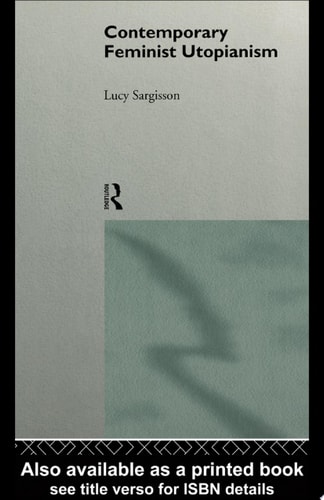
Contemporary Feminist Utopianism
0
0
As an Amazon Associate and affiliate partner, Menrva Books earns from qualifying purchases. Learn more
Author Description
Contemporary Feminist Utopianism explores current debates within utopian studies, feminist theory and poststructuralist deconstruction. Utopian thinking is offered as a route out of the dilemma of contemporary feminism as well as a way of conceptualizing its current situation. This book provides an exploration of, and exercise in, utopian thought.Divided into three parts, part one is concerned with approaches to utopianism. The approach taken to a phenomenon or idea informs the way that phenomenon or idea will be conceptualized. Different ways of approaching utopianism are examined and challenged. The function of utopian thought, it is suggested, is profoundly transgressive; it provokes paradigm shifts in consciousness. By reference to debates in contemporary feminism and through an exploration of the difference between utopian and poststructuralist thought, part two illustrates that this approach is the most appropriate when conceptualizing contemporary feminism. The third part of the study incorporates a thematic discussion of feminist utopian literature.A new and challenging entry into the debates between feminism and postmodernism, Contemporary Feminist Utopianism challenges some basic preconceptions about the role of political theory today. It offers a new way forward to those frustrated with traditional academic approaches to the world.
Menrva's Summary
THE THESIS
This book investigates the intersection of utopian thinking, feminist theory, and poststructuralist deconstruction to determine if utopianism offers a viable path forward for contemporary feminist discourse. Lucy Sargisson, a scholar in political theory, utilizes a multi-part framework to challenge traditional academic approaches to political thought. By examining the transgressive function of utopianism, she argues that such thinking is necessary to provoke paradigm shifts in consciousness and resolve current dilemmas within the feminist movement.
THE SCOPE MAP
What You Will Find
- A critical analysis of diverse methodological approaches to utopian studies.
- A comparative study between utopian thought and poststructuralist deconstruction.
- A thematic examination of contemporary feminist utopian literature.
- A theoretical framework for conceptualizing the current state of feminist politics.
THE AUTHORITY PERSPECTIVE
Scholars and students of political theory frequently cite this work as a significant contribution to the ongoing dialogue between feminism and postmodernism. Readers often note the academic density of the prose, which serves as a rigorous exercise in theoretical application for those interested in the future of political philosophy.
Page Count:
258
Publication Date:
2004-01-01
Publisher:
Taylor & Francis Inc
ISBN-10:
0203747038
ISBN-13:
9780203747032
Philosophy
Social Science
Politics
Political Theory
Sociology
Utopies
Feminism
Utopias
Nonfiction
Feminist Theory
Community Tags
Other Editions(7)




Similar Books







Reader Comments
Share Your Thoughts
No comments yet. Be the first to share your thoughts!