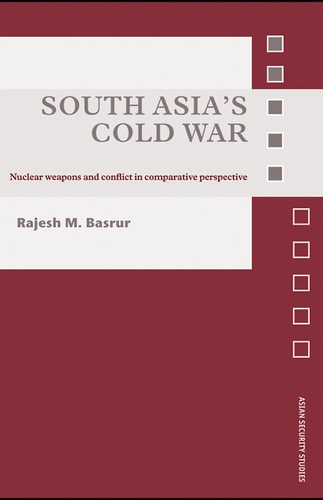
South Asia's Cold War: Nuclear Weapons and Conflict in Comparative Perspective
0
0
As an Amazon Associate and affiliate partner, Menrva Books earns from qualifying purchases. Learn more
Author Description
This book is a ground-breaking analysis of the India-Pakistan nuclear confrontation as a form of 'cold war' - that is, a hostile relationship between nuclear rivals. Drawing on nuclear rivalries between similar pairs (United States-Soviet Union, United States-China, Soviet Union-China, and United States-North Korea), the work examines the rise, process and potential end of the cold war between India and Pakistan.
Menrva's Summary
THE THESIS
This book investigates whether the nuclear confrontation between India and Pakistan functions as a structural 'Cold War' by comparing it to historical nuclear rivalries. Rajesh M. Basrur, a specialist in South Asian security, utilizes a comparative framework to analyze the dynamics of hostility between nuclear-armed states. By evaluating material and ideational factors, the author argues that the India-Pakistan relationship mirrors patterns observed in other major power rivalries, providing a lens through which to assess the potential for conflict resolution or long-term stability.
THE SCOPE MAP
What You Will Find
- Comparative analysis of nuclear rivalries including the United States, Soviet Union, China, and North Korea.
- Examination of the rise, process, and potential conclusion of the India-Pakistan nuclear standoff.
- Assessment of both material capabilities and ideational factors influencing regional security.
- Theoretical framework for understanding 'Cold War' dynamics in a contemporary South Asian context.
THE AUTHORITY PERSPECTIVE
Experts in Asian security studies recognize this work as a significant contribution to the comparative study of nuclear deterrence. Readers frequently note the academic rigor and the clarity with which the author applies historical models to the specific geopolitical tensions of the Indian subcontinent.
Page Count:
172
Publication Date:
2008-01-01
Publisher:
Routledge
ISBN-10:
0203928237
ISBN-13:
9780203928233
History
Nuclear weapons
India
Pakistan
Arms Race
International relations
South Asia
Military Strategy
Community Tags
Similar Books