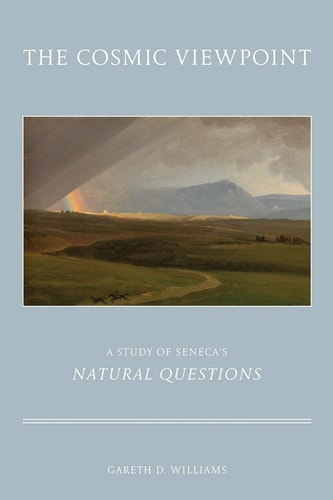
The Cosmic Viewpoint: A Study of Seneca's Natural Questions
0
0
As an Amazon Associate and affiliate partner, Menrva Books earns from qualifying purchases. Learn more
Author Description
Seneca's Natural Questions is an eight-book disquisition on the nature of meteorological phenomena, ranging inter alia from rainbows to earthquakes, from comets to the winds, from the causes of snow and hail to the reasons why the Nile floods in summer. Much of this material had been treated in the earlier Greco-Roman meteorological tradition, but what notoriously sets Seneca's writing apart is his insertion of extended moralizing sections within his technical discourse. How, if at all, are these outbursts against the luxury and vice that are apparently rampant in Seneca's first-century CE Rome to be reconciled with his main meteorological agenda?In grappling with this familiar question, The Cosmic Viewpoint argues that Seneca is no blinkered or arid meteorological investigator, but a creative explorer into nature's workings who offers a highly idiosyncratic blend of physico-moral investigation across his eight books. At one level, his inquiry into nature impinges on human conduct and morality in its implicit propagation of the familiar Stoic ideal of living in accordance with nature: the moral deviants whom Seneca condemns in the course of the work offer egregious examples of living contrary to nature's balanced way. At a deeper level, however, The Cosmic Viewpoint stresses the literary qualities and complexities that are essential to Seneca's literary art of science: his technical enquiries initiate a form of engagement with nature which distances the reader from the ordinary involvements and fragmentations of everyday life, instead centering our existence in the cosmic whole. From a figurative standpoint, Seneca's meteorological theme raises our gaze from a terrestrial level of existence to a more intuitive plane where literal vision gives way to "higher" conjecture and intuition: in striving to understand meteorological phenomena, we progress in an elevating direction--a conceptual climb that renders the Natural Questions no mere store of technical learning, but
Menrva's Summary
THE THESIS
*This study investigates how Seneca integrates technical meteorological discourse with moral philosophy in his work, Natural Questions.* Dr. Gareth D. Williams, a scholar of Latin literature, examines the intersection of scientific inquiry and Stoic ethics. He argues that Seneca uses the study of nature as a literary and philosophical tool to elevate the reader's perspective from mundane concerns to a broader cosmic understanding.
THE SCOPE MAP
What You Will Find
- Analysis of the eight books of Seneca's Natural Questions.
- Examination of the relationship between meteorological phenomena and Stoic moral ideals.
- Discussion of the literary art of science in first-century CE Roman writing.
Scope Limits
- The book does not provide a comprehensive scientific history of ancient meteorology independent of Seneca's specific philosophical framework.
THE AUTHORITY PERSPECTIVE
Scholars recognize this text as a significant contribution to the understanding of Seneca's intellectual methodology and literary style. It is frequently cited for its nuanced approach to reconciling the seemingly disparate technical and moral sections of the Natural Questions.
Page Count:
410
Publication Date:
2016-03-15
Publisher:
Oxford University Press
ISBN-10:
0190490985
ISBN-13:
9780190490980
Philosophy
stoicism
Science History
Literary Criticism
Community Tags
Similar Books