Monsters and Their Meanings in Early Modern Culture: Mighty Magic
0
0
As an Amazon Associate and affiliate partner, Menrva Books earns from qualifying purchases. Learn more
Author Description
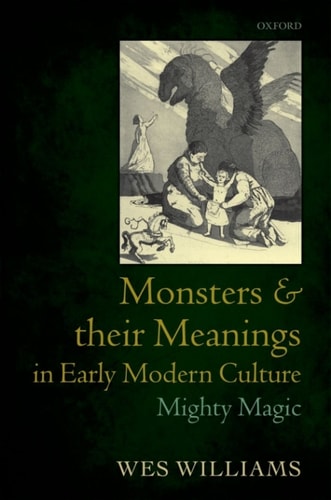
To call something 'monstrueux' in the mid-sixteenth century is, more often than not, to wonder at its enormous size: it is to call to mind something like a whale. By the late seventeenth 'monstrueux' is more likely to denote hidden intentions, unspoken desires. Several shifts are at work in this word history, and in what Othello calls the 'mighty magic' of monsters; these shifts can be described in a number of ways. The clearest, and most compelling, is the translation or migration of the monstrous from natural history to moral philosophy, from descriptions of creatures found in the external world to the drama of human motivation, of sexual and political identity. This interdisciplinary study of monsters and their meanings advances by way of a series of close readings supported by the exploration of a wide range of texts and images, from many diverse fields, which all concern themselves with illicit coupling, unarranged marriages, generic hybridity, and the politics of monstrosity. Engaging with recent, influential accounts of monstrosity - from literary critical work (Huet, Greenblatt, Thomson Burnett, Hampton), to histories of science and 'bio-politics' (Wilson, Céard, Foucault, Daston and Park, Agamben) - it focusses on the ways in which monsters give particular force, colour, and shape to the imagination; the image at its centre is the triangulated picture of Andromeda, Perseus and the monster, approaching. The centre of the book's gravity is French culture, but it also explores Shakespeare, and Italian, German, and Latin culture, as well as the ways in which the monstrous tales and images of Antiquity were revived across the period, and survive into our own times.
Menrva's Summary
THE THESIS
This book investigates the semantic and conceptual evolution of the term 'monstrous' in early modern culture, tracing its migration from natural history to moral philosophy. Author Wes Williams, a scholar of early modern French literature, utilizes a multidisciplinary framework to analyze how the perception of monsters shifted from physical anomalies to metaphors for human motivation, sexual identity, and political power. By examining the 'mighty magic' of these figures, the text argues that the monstrous serves as a critical lens through which to view the anxieties and imaginative structures of the period.
THE SCOPE MAP
What You Will Find
- A diachronic analysis of the term 'monstrueux' from the mid-sixteenth to the late seventeenth century.
- Close readings of diverse texts and visual imagery concerning illicit coupling and generic hybridity.
- Engagement with critical theories from Foucault, Greenblatt, Daston, Park, and Agamben.
Scope Limits
- While the study incorporates Shakespeare and Italian, German, and Latin sources, it maintains a primary focus on French culture.
- The analysis does not provide an exhaustive catalog of all monstrous creatures but rather focuses on the conceptual shifts in the idea of the monster.
THE AUTHORITY PERSPECTIVE
Scholars and students of early modern studies frequently cite this work for its sophisticated interdisciplinary approach to cultural history. Readers note the academic density of the prose, which effectively synthesizes literary criticism with the history of science and political theory.
Page Count:
360
Publication Date:
2011-01-01
Publisher:
Oxford University Press
ISBN-10:
019161789X
ISBN-13:
9780191617898
Philosophy
History
Science History
Art european
Literary Criticism
English & College Success
History - Modern
English
Science europe
Community Tags
Similar Books