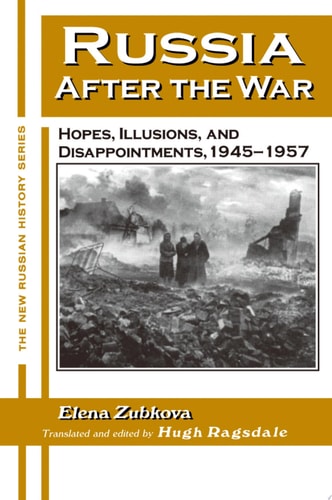
Russia After the War: Hopes, Illusions and Disappointments, 1945-1957
0
0
As an Amazon Associate and affiliate partner, Menrva Books earns from qualifying purchases. Learn more
Author Description
The years of late Stalinism are one of the murkiest periods in Soviet history, best known to us through the voices of Ehrenburg, Khrushchev and Solzhenitsyn. This is a sweeping history of Russia from the end of the war to the Thaw by one of Russia's respected younger historians. Drawing on the resources of newly opened archives as well as the recent outpouring of published diaries and memoirs, Elena Zubkova presents a richly detailed portrayal of the basic conditions of people's lives in Soviet Russia from 1945 to 1957. She brings out the dynamics of postwar popular expectations and the cultural stirrings set in motion by the wartime experience versus the regime's determination to reassert command over territories and populations and the mechanisms of repression. Her interpretation of the period establishes the context for the liberalizing and reformist impulses that surfaced in the post-Stalin succession struggle, characterizing what would be the formative period for a future generation of leaders: Gorbachev, Yeltsin and their contemporaries.
Menrva's Summary
THE THESIS
This book investigates the complex socio-political landscape of Soviet Russia in the crucial years between the end of World War II and the beginning of the Thaw. Elena Zubkova, a respected Russian historian, draws upon newly accessible archival materials and a wealth of published personal accounts to reconstruct the daily lives and evolving expectations of ordinary Soviet citizens. The narrative navigates the tension between the populace's wartime-forged aspirations and the state's renewed efforts to exert control through repression. This period is presented as foundational for the subsequent reformist movements and the leaders who would shape modern Russia.
THE SCOPE MAP
- Detailed analysis of the period of late Stalinism (1945-1957).
- Exploration of popular expectations and cultural shifts following wartime experiences.
- Examination of the Soviet regime's reassertion of control and mechanisms of repression.
- Contextualization of the liberalizing and reformist impulses that emerged post-Stalin.
- Insights into the formative period for future Russian leaders like Gorbachev and Yeltsin.
- Rich portrayal of basic living conditions in Soviet Russia during the specified years.
THE AUTHORITY PERSPECTIVE
The book is presented as a significant historical account of a complex and often opaque period in Soviet history, drawing on newly opened archives and personal testimonies. Its strength lies in Zubkova's detailed portrayal of daily life and the dynamics between popular hopes and state control. The interpretation offered establishes a crucial context for understanding the later reformist movements and the emergence of key political figures. The work is positioned as essential for comprehending the trajectory of post-Stalin Russia.
Page Count:
250
Publication Date:
2015-03-04
Publisher:
Routledge
ISBN-10:
1317460588
ISBN-13:
9781317460589
Non-Fiction
History
Soviet History
Community Tags
Similar Books