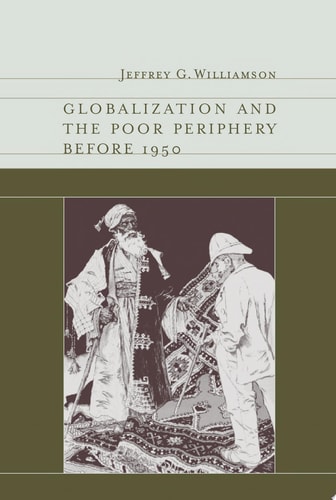
Globalization and the Poor Periphery before 1950
0
0
As an Amazon Associate and affiliate partner, Menrva Books earns from qualifying purchases. Learn more
Author Description
A leading authority on economic globalization argues that industrialization in the core countries of northwest Europe and its overseas settlements combined with a worldwide revolution in transportation to produce deindustrialization and an antiglobal backlash in industrially lagging poorer countries. In Globalization and the Poor Periphery before 1950 Jeffrey Williamson examines globalization through the lens of both the economist and the historian, analyzing its economic impact on industrially lagging poor countries in the nineteenth and early twentieth centuries. Williamson argues that industrialization in the core countries of northwest Europe and their overseas settlements, combined with a worldwide revolution in transportation, created an antiglobal backlash in the periphery, the poorer countries of eastern and southern Europe, the Middle East, Africa, Asia, and Latin America. During the "first global century," from about 1820 to 1913, and the antiglobal autarkic interwar period from 1914 to 1940, new methods of transportation integrated world commodity markets and caused a boom in trade between the core and the periphery. Rapid productivity growth, which lowered the price of manufactured goods, led to a soaring demand in the core countries for raw materials supplied by the periphery. When the boom turned into bust, after almost a century and a half, the gap in living standards between the core and the periphery was even wider than it had been at the beginning of the cycle. The periphery, argues Williamson, obeyed the laws of motion of the international economy. Synthesizing and summarizing fifteen years of Williamson's pioneering work on globalization, the book documents these laws of motion in the periphery, assesses their distribution and growth consequences, and examines the response of trade policy in these regions.
Menrva's Summary
THE THESIS
This book investigates how globalization impacted industrially lagging countries before 1950. Jeffrey G. Williamson, a leading authority on economic globalization, examines the period from 1820 to 1940, analyzing the economic consequences for the global periphery. He argues that industrialization in core countries and advancements in transportation led to deindustrialization and an anti-global backlash in poorer regions. The book details how the integration of world commodity markets and soaring demand for raw materials widened the gap in living standards between the core and the periphery, demonstrating that these regions followed predictable patterns within the international economy.
THE SCOPE MAP
- Analysis of the "first global century" (c. 1820-1913) and the antiglobal interwar period (1914-1940).
- Examination of the impact of transportation revolutions on global trade.
- Study of the core-periphery dynamic: industrialization in the core and raw material demand from the periphery.
- Assessment of the widening gap in living standards between industrialized nations and lagging countries.
- Documentation of the "laws of motion" governing the global periphery's economic development.
- Evaluation of the distribution and growth consequences of these economic forces.
- Analysis of trade policy responses in peripheral regions.
THE AUTHORITY PERSPECTIVE
Jeffrey G. Williamson's work is recognized for its comprehensive analysis of historical globalization's impact on poorer nations. The book synthesizes extensive research, presenting a clear argument about the economic forces that shaped the periphery. It is regarded as a significant contribution to understanding the long-term economic disparities between industrialized core countries and the rest of the world. The research highlights the predictable patterns of economic development and the consequences of global market integration for lagging economies.
Page Count:
208
Publication Date:
2009-08-21
Publisher:
MIT Press
ISBN-10:
0262250314
ISBN-13:
9780262250313
Economics
History
Non-Fiction
Economic History
Community Tags
Other Editions(2)
Similar Books











Reader Comments
Share Your Thoughts
No comments yet. Be the first to share your thoughts!