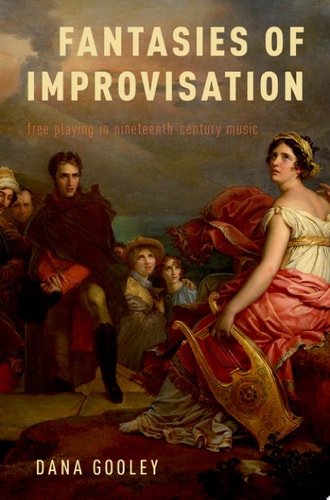
Fantasies of Improvisation: Free Playing in Nineteenth-Century Music
0
0
As an Amazon Associate and affiliate partner, Menrva Books earns from qualifying purchases. Learn more
Author Description
The first history of keyboard improvisation in European music in the postclassical and romantic periods, Fantasies of Improvisation: Free Playing in Nineteenth-Century Music documents practices of improvisation on the piano and the organ, with a particular emphasis on free fantasies and other forms of free playing. Case studies of performers such as Abbé Vogler, J. N. Hummel, Ignaz Moscheles, Robert Schumann, Carl Loewe, and Franz Liszt describe in detail the motives, intentions, and musical styles of the nineteenth century's leading improvisers. Grounded in primary sources, the book further discusses the reception and valuation of improvisational performances by colleagues, audiences, and critics, which prompted many keyboardists to stop improvising. Author Dana Gooley argues that amidst the decline of improvisational practices in the first half of the nineteenth century there emerged a strong and influential "idea" of improvisation as an ideal or perfect performance. This idea, spawned and nourished by romanticism, preserved the aesthetic, social, and ethical values associated with improvisation, calling into question the supposed triumph of the "work."
Menrva's Summary
THE THESIS
How did the practice and cultural perception of keyboard improvisation evolve during the nineteenth century as the concept of the musical 'work' gained dominance? Dana Gooley, a scholar of musicology, utilizes a wide array of primary sources, including contemporary reviews, pedagogical treatises, and performance accounts, to reconstruct the lost art of free playing. He argues that while actual improvisational practice declined, the romantic ideal of improvisation persisted as a powerful aesthetic and ethical framework that challenged the rigid fixation on written scores.
THE SCOPE MAP
What You Will Find
- Historical analysis of keyboard improvisation on piano and organ in the postclassical and romantic eras.
- Detailed case studies of prominent improvisers including Abbé Vogler, J. N. Hummel, Ignaz Moscheles, Robert Schumann, Carl Loewe, and Franz Liszt.
- Examination of the social and critical reception of improvisational performances.
Scope Limits
- The book focuses primarily on keyboard instruments and does not provide an exhaustive history of improvisation across all instrumental mediums.
- It does not serve as a practical manual for learning to improvise but rather as a historical and cultural study.
THE AUTHORITY PERSPECTIVE
Experts recognize this work as a significant contribution to the study of nineteenth-century performance practice, noting its success in bridging the gap between musicology and cultural history. Readers frequently highlight the depth of the archival research and the clarity with which Gooley navigates the tension between the written score and the spontaneous performance.
Page Count:
312
Publication Date:
2018-01-01
Publisher:
Oxford University Press
ISBN-10:
0190633603
ISBN-13:
9780190633608
Romanticism
Piano
Music History
Musicology
Cultural History
Humanities
Community Tags
Similar Books