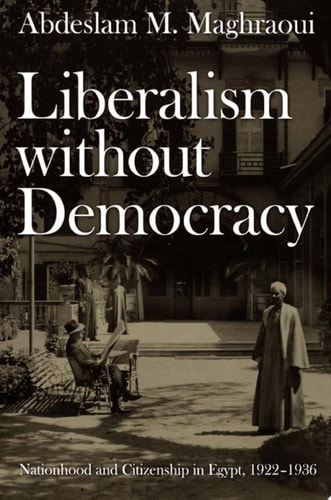
Liberalism without Democracy: Nationhood and Citizenship in Egypt, 1922–1936
0
0
As an Amazon Associate and affiliate partner, Menrva Books earns from qualifying purchases. Learn more
Author Description
The history of Western intervention in the Middle East stretches from the late eighteenth century to the present day. All too often, the Western rationale for invading and occupying a country to liberate its people has produced new forms of domination that have hindered rather than encouraged the emergence of democratic politics. Abdeslam M. Maghraoui advances the understanding of this problematic dynamic through an analysis of efforts to achieve liberal reform in Egypt following its independence from Great Britain in 1922. In the 1920s and 1930s, Egypt's reformers equated liberal notions of nationhood and citizenship with European civilization and culture. As Maghraoui demonstrates, in their efforts to achieve liberalization, they sought to align Egypt with the West and to dissociate it from the Arab and Islamic worlds. Egypt's professionals and leading cultural figures attempted to replace the fez with European-style hats; they discouraged literary critics from studying Arabic poetry, claiming it was alien to Egyptian culture. Why did they feel compelled to degrade local cultures in order to accommodate liberal principles? Drawing on the thought of Lacan, Fanon, Said, and Bhabha, as well as contemporary political theory, Maghraoui points to liberalism's inherent contradiction: its simultaneous commitments to individual liberty and colonial conquest. He argues that when Egypt's reformers embraced the language of liberalism as their own, they adopted social prejudices built into that language. Efforts to achieve liberalization played out—and failed—within the realm of culture, not just within the political arena. Opinions voiced through literary works, cartoons, newspaper articles on controversial social issues, and other forms of cultural expression were ultimately more important to the fate of liberalism in Egypt than were questions of formal political participation and representation. Liberalism without Democracy demonstrates the powerful—and under
Menrva's Summary
THE THESIS
The central question of this book is how liberal reforms in Egypt between 1922 and 1936, influenced by Western intervention, paradoxically hindered democratic development. The author examines how Egyptian reformers equated liberalism with European civilization, leading them to distance Egypt from its Arab and Islamic heritage, evident in attempts to adopt European cultural markers and devalue Arabic literature. This work explores the inherent contradiction within liberalism, its simultaneous espousal of individual liberty and colonial conquest, and how this tension played out culturally. The analysis posits that cultural expression and opinion were more critical to liberalism's fate in Egypt than formal political participation.
THE SCOPE MAP
- Analysis of liberal reform efforts in Egypt post-1922 independence.
- Examination of the equation of liberalism with European civilization and culture.
- Exploration of the dissociation from Arab and Islamic worlds by Egyptian reformers.
- Discussion of cultural shifts, including changes in attire and literary studies.
- Theoretical framework drawing on Lacan, Fanon, Said, and Bhabha.
- Argument about liberalism's inherent contradiction: individual liberty vs. colonial conquest.
- Focus on the role of cultural expression and opinion in the failure of liberalism.
THE AUTHORITY PERSPECTIVE
This book analyzes the complex relationship between liberalism, nationhood, and citizenship in Egypt during a pivotal period of its history. It critically examines how the adoption of Western liberal ideals by Egyptian reformers led to a cultural alienation and a paradoxical hindrance to democratic progress. The work highlights the internal contradictions of liberalism and its historical entanglement with colonial discourse. Ultimately, the book argues that cultural expression played a more significant role in shaping the trajectory of liberalism in Egypt than purely political mechanisms.
Page Count:
216
Publication Date:
2006-12-01
Publisher:
Duke University Press
ISBN-10:
0822388383
ISBN-13:
9780822388388
Non-Fiction
Politics
History
Cultural History
Liberalism
Citizenship
Community Tags
Similar Books






Reader Comments
Share Your Thoughts
No comments yet. Be the first to share your thoughts!