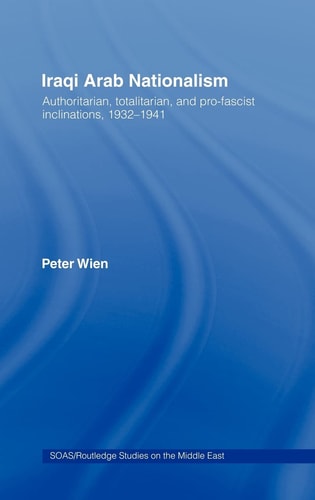
Iraqi Arab Nationalism: Authoritarian, Totalitarian, and Pro-fascist Inclinations, 1932-1941
0
0
As an Amazon Associate and affiliate partner, Menrva Books earns from qualifying purchases. Learn more
Author Description
Peter Wien presents a provocative discussion on the history of Iraq and the growth of nationalism during the 1930s and early 1940s. He deconstructs the established view that a large proportion of the nationalist movement in Iraq during this period was heavily influenced by Nazi Germany, arguing that the admiration for Germany was highly nuanced, and only rarely translated into admiration for Nazism. National unity and patriotism were important, but models of leadership were overwhelmingly based on Iraqis and not Hitler. Analyzing the activities of the Iraqi youth and Jewish Iraqis, Iraqi Arab Nationalism gives an understanding of Iraqis from diverse backgrounds. It incorporates source material not previously used in discussions of Iraq and nationalism and contains autobiographical and biographical material from officers, intellectuals and politicians, along with contemporary journalistic writings, which sheds new light on Iraqi nationalism.
Menrva's Summary
THE THESIS
This book investigates the complex and often misunderstood nature of Iraqi Arab nationalism between 1932 and 1941, challenging the prevailing view of its direct alignment with Nazi Germany. Peter Wien critically examines the period, arguing that while admiration for Germany existed, it was nuanced and rarely equated to an endorsement of Nazism itself. The study focuses on the development of national unity and patriotism, emphasizing that leadership models were predominantly Iraqi rather than derived from Hitler. By analyzing the activities of various groups, including Iraqi youth and Jewish Iraqis, the book offers a multifaceted understanding of Iraqi society and its nationalist aspirations during this pivotal era.
THE SCOPE MAP
- Analysis of the historical development of Iraqi Arab nationalism from 1932 to 1941.
- Deconstruction of the established narrative linking Iraqi nationalism to Nazi Germany.
- Examination of the nuanced relationship between admiration for Germany and Nazism.
- Focus on the importance of national unity and patriotism within the Iraqi context.
- Exploration of Iraqi leadership models and their indigenous origins.
- Inclusion of source material previously unused in discussions of Iraqi nationalism.
- Analysis of the activities and perspectives of Iraqi youth.
- Consideration of the role and experiences of Jewish Iraqis within the nationalist movement.
THE AUTHORITY PERSPECTIVE
Peter Wien's work offers a provocative re-evaluation of Iraqi Arab nationalism during a critical interwar period. The book challenges conventional interpretations by highlighting the nuanced admiration for Germany, distinguishing it from a wholesale adoption of Nazism. By incorporating previously underutilized source materials and examining diverse societal groups, Wien provides a more intricate understanding of the period's political and social dynamics. The scholarly approach and detailed analysis are likely to appeal to specialists in Middle Eastern history and political science.
Page Count:
162
Publication Date:
2006-01-01
Publisher:
Routledge
ISBN-10:
0415368588
ISBN-13:
9780415368582
History
Non-Fiction
Politics
Nationalism
Community Tags
Similar Books