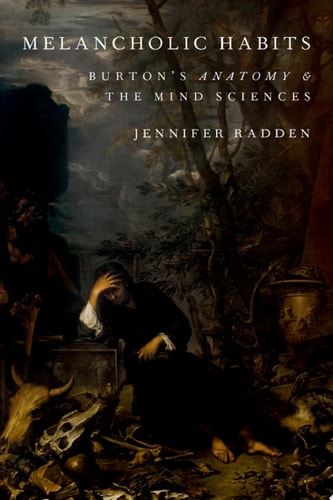
Melancholic Habits: Burton's Anatomy & the Mind Sciences
0
0
As an Amazon Associate and affiliate partner, Menrva Books earns from qualifying purchases. Learn more
Author Description
Jennifer Radden here provides a re-interpretation of the classic text by 17th century scholar Robert Burton, The Anatomy of Melancholy. Her new reading of Burton's essential text brings several key facets of his thought to light: the role of imagination in inciting and averting melancholy as disorder; the part played by daily habits of thought in engendering severe and incurable conditions; the multi-directional feedback loops linking feeling and thought in his model of mind; and an emphasis on symptoms and natural history in his understanding of disease. Much of Burton's account is derived from classical, medieval and renaissance writing about melancholy, yet he brought them together into something new: an account that -- while it stands in contrast to many of the assumptions of later psychology -- concurs surprisingly well with present day cognitivism. Moreover, although seventeenth century melancholy bears only a loose relationship to present day mood disorders such as depression and anxiety, on this reading the Anatomy anticipates a considerable number of findings and hypotheses associated with present day psychiatry, including its network models of depression, for example, and its emphasis on the part played by rumination and mind wandering in engendering affective disorder. Radden's new reading of a classic text should interest readers in philosophy of mind and psychiatry, clinical psychiatry and the history of medicine.
Menrva's Summary
THE THESIS
This book investigates the extent to which Robert Burton’s 17th-century text, The Anatomy of Melancholy, anticipates contemporary cognitive models of mental disorder. Jennifer Radden, a scholar of philosophy and psychiatry, utilizes a historical and analytical framework to re-examine Burton’s work. By synthesizing classical, medieval, and Renaissance medical traditions, she argues that Burton’s focus on habit, imagination, and feedback loops aligns with modern psychiatric theories regarding rumination and affective disorders.
THE SCOPE MAP
What You Will Find
- Analysis of the role of imagination in the development of melancholy.
- Examination of feedback loops between thought and feeling in 17th-century medical thought.
- Comparison between Burton’s natural history of disease and modern cognitivism.
- Discussion of the relationship between historical melancholy and modern mood disorders like depression and anxiety.
Scope Limits
- The text does not claim that 17th-century melancholy is identical to modern clinical depression.
- It does not provide a comprehensive biography of Robert Burton, focusing instead on his theoretical contributions to the mind sciences.
THE AUTHORITY PERSPECTIVE
Experts in the history of medicine and philosophy of mind recognize this work as a significant bridge between early modern thought and contemporary psychiatry. Readers frequently note the academic density of the prose, which is tailored for scholars and clinicians interested in the evolution of mental health theory.
Page Count:
335
Publication Date:
2016-01-01
Publisher:
Oxford University Press
ISBN-10:
0190651504
ISBN-13:
9780190651503
Philosophy
Psychiatry
Mind & Body
Melancholy
Intellectual History
Medicine history
Community Tags
Similar Books