
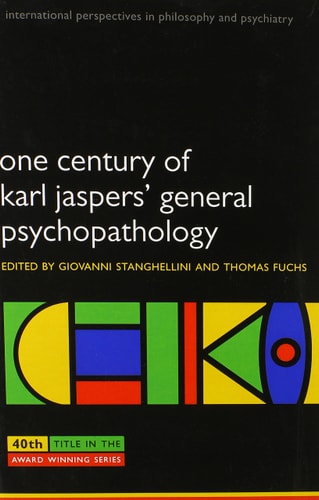
One Century of Karl Jaspers' General Psychopathology
0
0
As an Amazon Associate and affiliate partner, Menrva Books earns from qualifying purchases. Learn more
Author Description
2013 sees the centenary of Jaspers' foundation of psychopathology as a science in its own right. In 1913 Karl Jaspers published his psychiatric opus magnum - the Allgemeine Psychopathologie (General Psychopathology). Jaspers was working at a time much like our own - with rapid expansion in the neurosciences, and responding to the philosophical challenges that this raised. The idea inspiring his book was very simple: to bring order into the chaos of abnormal psychic phenomena by rigorous description, definition and classification, and to empower psychiatry with a valid and reliable method to assess and make sense of abnormal human subjectivity. After almost one century, many of the concepts challenged by Jaspers are still at issue, and Jaspers' investigation is even now the ground for analyses and discussions. With a new edition of the Diagnostic and Statistical Manual (DSM) imminent, many of the issues concerning methodology and diagnosis are still the subject of much discussion and debate. This volume brings together leading psychiatrists and philosophers to discuss and evaluate the impact of this volume, its relevance today, and the legacy it left. "Jaspers' General Psychopathology is not an easy text to read. Especially nowadays, in the Internet era, it may appear in several parts obscure, convoluted, or repetitive. This is why the present volume has the potential to be not only attractive to scholars, but also extremely useful for young psychiatrists and busy clinicians. It may represent for them a 'guide' to the reading of that ponderous text, helping them to extract the key messages that are likely to resonate with, and at the same time enrich, their clinical practice and theoretical reflection." - From the Introduction by Mario Maj
Menrva's Summary
THE THESIS
This volume investigates the enduring relevance and methodological impact of Karl Jaspers' 1913 foundational text, General Psychopathology, one century after its initial publication. Editors Giovanni Stanghellini and Thomas Fuchs assemble a collection of essays from prominent psychiatrists and philosophers to evaluate how Jaspers' rigorous approach to abnormal human subjectivity informs contemporary clinical practice. The text addresses the ongoing tension between rapid neuroscientific expansion and the necessity for a structured, descriptive framework in psychiatric diagnosis.
THE SCOPE MAP
What You Will Find
- Historical analysis of the development of psychopathology as a scientific discipline.
- Methodological critiques of psychiatric classification systems, including the DSM.
- Philosophical examinations of abnormal psychic phenomena and human subjectivity.
- Expert commentary on the application of Jaspersian concepts in modern clinical settings.
Scope Limits
- The text does not serve as a primary source translation of Jaspers' original work.
- It does not provide a comprehensive clinical manual for treating specific psychiatric disorders.
THE AUTHORITY PERSPECTIVE
Experts and clinicians identify this volume as a critical companion for navigating the complexities of Jaspers' original, often dense, psychiatric opus. Readers frequently note that the collection provides a necessary bridge for contemporary practitioners to apply historical philosophical rigor to modern diagnostic debates.
Page Count:
344
Publication Date:
2013-01-01
Publisher:
OUP Oxford
ISBN-10:
0191506478
ISBN-13:
9780191506475
Philosophy
Psychiatry
Allied Health
Medical
Medicine history
Mind & Body
Community Tags
Other Editions(4)


Similar Books












Reader Comments
Share Your Thoughts
No comments yet. Be the first to share your thoughts!