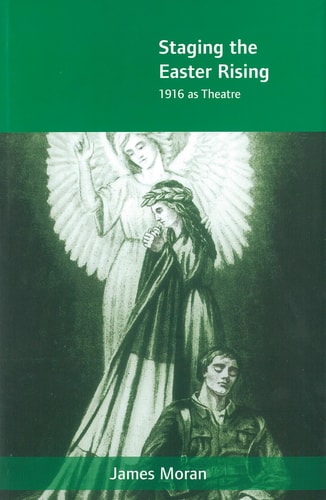
Staging the Easter Rising: 1916 as Theatre
0
0
As an Amazon Associate and affiliate partner, Menrva Books earns from qualifying purchases. Learn more
Author Description
An exciting new interpretation of 1916 as theatre and its later representation on the stage, with a particular focus on gender. "Both stylistically and conceptually, the author works in broad vivid strokes, ultimately producing a book that re-imagines familiar territory in an original and often unexpected way. This is a brave book, one that wades into the undergrowth of some of the bigger and more perilous jungles of Irish cultural debate: Yeats, Casement, the women of 1916, the Abbey and elitism, de Valera, revisionism." -- Christopher Morash This is the most original exploration of representations of the 1916 Rising since William Irwin Thompson's 1967 classic, The Imagination of an Insurrection. It offers new insights into the studied theatricality of the rising, in the context of plays by Pearse and MacDonagh and a rediscovered play of Connolly's Under Which Flag? The book argues that the Rising set out to proclaim sexual equality as well as political independence, but that, while the myth of 1916 became central to Irish political and cultural life, the rebels' radical ideas about gender were ignored. New readings and contexts are provided for O'Casey's The Plough and the Stars and for Yeats's The Dreaming of the Bones. The role of de Valera in the shaping of official commemoration is assessed, while the intervention of Shaw throws new light on the Casement controversy. Surveying representations of the Rising in more recent Irish theatre, especially since the 1966 commemoration, the author shows how gender issues have resurfaced.
Menrva's Summary
THE THESIS
This book offers a novel interpretation of the 1916 Easter Rising, examining its theatrical staging and subsequent representation on stage, with a particular emphasis on gender dynamics.
THE SCOPE MAP
- Analysis of the theatricality inherent in the 1916 Rising itself.
- Examination of plays by Pearse, MacDonagh, and Connolly, including a rediscovered play by Connolly.
- Argument that the Rising proclaimed sexual equality alongside political independence, a radical gender aspect that was subsequently ignored.
- New readings of O'Casey's 'The Plough and the Stars' and Yeats's 'The Dreaming of the Bones'.
- Assessment of de Valera's role in shaping official commemoration.
- Exploration of Shaw's intervention and its light on the Casement controversy.
- Survey of representations of the Rising in recent Irish theatre, particularly since the 1966 commemoration, focusing on the resurgence of gender issues.
THE AUTHORITY PERSPECTIVE
The book is lauded for its originality in re-imagining the 1916 Rising as theatre, offering a fresh perspective on familiar historical territory. Critics highlight its broad conceptual strokes and its willingness to engage with complex cultural debates surrounding Irish identity, literature, and politics. The work is recognized for providing new insights into the deliberate theatricality of the event and the often-overlooked radical gender politics espoused by the rebels. Its analysis of key plays and figures, from Yeats and O'Casey to de Valera and Casement, is seen as particularly insightful, especially in tracing the re-emergence of gender issues in later theatrical representations.
Page Count:
260
Publication Date:
2006-03-31
Publisher:
Cork University Press
ISBN-10:
1859184014
ISBN-13:
9781859184011
History
Non-Fiction
Gender Studies
Theatre studies
Irish History
Community Tags
Similar Books