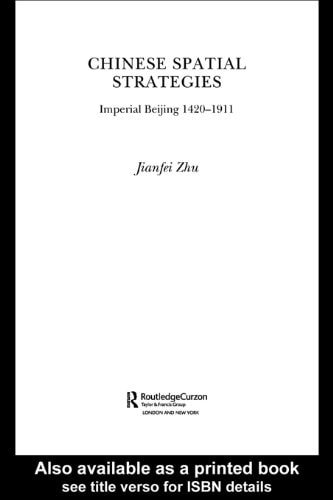
Chinese Spatial Strategies: Imperial Beijing, 1420-1911
0
0
As an Amazon Associate and affiliate partner, Menrva Books earns from qualifying purchases. Learn more
Author Description
How do the Chinese design a space? What are the similarities and differences between spaces designed for palaces and cities? How were the extension of the Great Wall, the reopening of the Grand Canal and the building of Beijing interrelated? By closely examining the buildings of Imperial Beijing (1420-1911) this book seeks to answer these questions by exploring whether there is a generic approach to spatial disposition in the Chinese tradition. Chinese Spatial Strategiesconsiders spatial design on many levels and in different aspects including: *The geo-political design of a map of Asia *The layout of the city as a representation of imperial ideology *The city as a social realm of interrelations between the central authority and local urban society *The Forbidden City as an apparatus of power *A comparison between European visual compositions and the aesthetic composition of Beijing. Drawing upon recent work in social theory, the author provides a spatial and political analysis of the Forbidden City and a realistic account of Imperial Beijing. This book challenges the convention of formal description of Chinese cities and will appeal to all those with an interest in Chinese buildings and architecture.
Menrva's Summary
THE THESIS
This book investigates the underlying principles of Chinese spatial design by examining Imperial Beijing from 1420 to 1911. It explores whether a consistent approach to spatial disposition exists within the Chinese tradition, comparing palace and city designs, and analyzing the interrelationships between major infrastructure projects like the Great Wall and the Grand Canal. The author draws on social theory to provide a spatial and political analysis of the Forbidden City and Imperial Beijing, challenging conventional formal descriptions of Chinese cities.
THE SCOPE MAP
- The geo-political design of a map of Asia
- The layout of the city as a representation of imperial ideology
- The city as a social realm of interrelations between central authority and local urban society
- The Forbidden City as an apparatus of power
- A comparison between European visual compositions and the aesthetic composition of Beijing
THE AUTHORITY PERSPECTIVE
This book is regarded as a significant contribution to the study of Chinese urbanism and architecture, offering a novel spatial and political analysis of Imperial Beijing. It challenges traditional descriptive methods by integrating social theory to understand the city's design and its representation of imperial ideology. The work is expected to appeal to scholars and enthusiasts of Chinese buildings, architecture, and history.
Page Count:
281
Publication Date:
2004-01-01
Publisher:
Psychology Press
ISBN-10:
0415318831
ISBN-13:
9780415318839
Architecture
Non-Fiction
History
Imperialism
Chinese History
urban planning