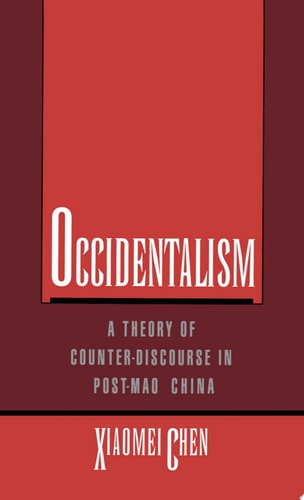
Occidentalism: A Theory of Counter-Discourse in Post-Mao China
0
0
As an Amazon Associate and affiliate partner, Menrva Books earns from qualifying purchases. Learn more
Author Description
Xiaomei Chen offers an insightful account of the unremittingly favorable depiction of Western culture and its negative characterization of Chinese culture in post-Mao China from 1978-1988. Chen examines the cultural and political interrelations between the East and West from a vantage point more complex than that accommodated by most current theories of Western imperialism and colonialism. Going beyond Edward Said's construction in Orientalism of cross-cultural appropriations as a defining facet of Western imperialism, Chen argues that the appropriation of Western discourse--what she calls "Occidentalism"--can have a politically and ideologically liberating effect on contemporary non-Western culture. Using China as a focus of her analysis, Chen examines a variety of cultural media, from Shakesperian drama, to Western modernist poetry, to contemporary Chinese television. She thus places sinology in the general context of Western theoretical discourses, such as Eurocentrism, postcolonialism, nationalism, modernism, feminism, and literary hermeneutics, showing that it has a vital role to play in the study of Orient and Occident and their now unavoidable symbiotic relationship. Occidentalism presents a new model of comparative literary and cultural studies that reenvisions cross-cultural appropriation.
Menrva's Summary
THE THESIS
How does the appropriation of Western discourse within post-Mao China function as a tool for political and ideological liberation rather than mere imitation? Xiaomei Chen, a scholar of Chinese literature and comparative studies, utilizes a framework of counter-discourse to challenge traditional binary models of imperialism. She argues that the Chinese adoption of Western cultural tropes serves as a strategic mechanism for internal social critique and the redefinition of national identity.
THE SCOPE MAP
What You Will Find
- Analysis of cultural media including Shakespearean drama, modernist poetry, and television broadcasts.
- A theoretical framework contrasting Occidentalism with Edward Said's concept of Orientalism.
- Examination of the 1978-1988 decade in China as a period of intense cultural negotiation.
Scope Limits
- The study focuses primarily on the decade following the Cultural Revolution and does not extend into 21st-century digital globalization.
- The analysis is restricted to the specific context of Chinese intellectual and artistic responses to Western influence.
THE AUTHORITY PERSPECTIVE
Scholars frequently cite this work as a foundational text for understanding the complexities of cross-cultural appropriation in non-Western contexts. Experts note that the prose is academically dense, requiring a firm grasp of postcolonial theory and literary hermeneutics to fully appreciate the author's arguments.
Page Count:
237
Publication Date:
1995-01-01
Publisher:
Oxford University Press
ISBN-10:
0190282142
ISBN-13:
9780190282141
English & College Success
Postcolonial Theory
Sociology
Criticism history
East and West
English
Literary Criticism
Chinese History
Community Tags
Similar Books