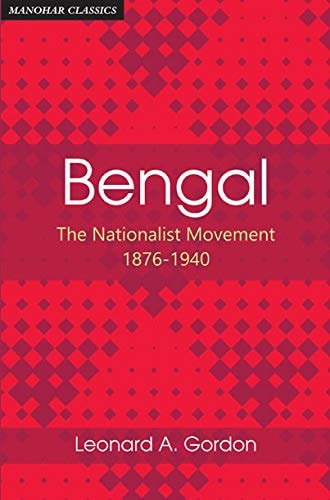
Bengal: The Nationalist Movement 1876-1940
0
0
As an Amazon Associate and affiliate partner, Menrva Books earns from qualifying purchases. Learn more
Author Description
Nationalism in India developed unevenly in different regions and drew upon varied cultural traditions and diverse socio-political conditions. This work analyses the interplay of Indian nationalism and Bengali regionalism from the later nineteenth century to 1940 in one of India's most troubled areas. As large in population as France and Germany combined, Bengal has always been an area of major importance in the Indian subcontinent. Calcutta, its principal city, was the capital of the British Indian Empire for nearly a century and a half, during which time it grew considerably in size and influence as a centre of both government and business. Thus by reason of proximity the Bengali people were more closely involved with British rule than any other specific group in India. They also had more opportunities for education and developed a greater political awareness. Today the region is split into West Bengal, which is part of India, and Bangladesh, which was formerly part of Pakistan. This division, largely along Hindu/Muslim lines, was made at the end of British rule in 1947. The total population now is well in excess of 115 million and there is a great deal of both national and regional consciousness in both parts of Bengal. Based on nationalist sources, government records, and interviews, the present volume traces the emergence of professional politicians attempting to mobilize the masses, and revolutionaries devoted to violent upheaval. A general account of the national movement in Bengal is interwoven with detailed portraits of such important leaders as R.C. Dutt, Aurobindo Ghose, C.R. Das, and Subhas Bose. Politically-conscious Bengalis passed from early pre-eminence in the movement to a much more limited role once Mahatma Gandhi gained control over the Indian National Congress. The final and longest section of the book deals with the years from 1918 to 1940 when Bengal was out of step with the main line of the Gandhian movement, and examines B
Menrva's Summary
THE THESIS
The book investigates the complex interplay between Indian nationalism and Bengali regionalism during a pivotal period of political and social upheaval. It examines how diverse cultural traditions and socio-political conditions shaped the development of nationalism in Bengal, a region with a unique relationship with British rule due to Calcutta's status as the imperial capital. The work analyzes the emergence of political leaders, from early figures to revolutionaries, and their efforts to mobilize the masses. It also details how Bengali political consciousness evolved, particularly in relation to Mahatma Gandhi's leadership of the Indian National Congress, and explores Bengal's distinct path during the Gandhian movement.
THE SCOPE MAP
- Analysis of the development of nationalism in India, focusing on regional variations.
- Detailed examination of Bengali regionalism from the late 19th century to 1940.
- Exploration of the socio-political conditions and cultural traditions influencing Bengali nationalism.
- Biographical sketches of key leaders such as R.C. Dutt, Aurobindo Ghose, C.R. Das, and Subhas Bose.
- Discussion of the role of professional politicians and revolutionaries in mobilizing the masses.
- An account of the shifting influence of Bengali leaders within the broader Indian National Congress.
- Focus on the period from 1918 to 1940, highlighting Bengal's divergence from the main Gandhian movement.
THE AUTHORITY PERSPECTIVE
This volume is based on nationalist sources, government records, and interviews, providing a detailed account of the nationalist movement in Bengal. It offers insights into the emergence of political figures and their strategies for mass mobilization, as well as the evolution of Bengali political thought in relation to national movements. The book is noted for its interwoven narrative of the general national movement with specific portraits of influential leaders. Its final section critically examines Bengal's distinct political trajectory during the Gandhian era.
Page Count:
424
Publication Date:
2024-11-20
Publisher:
Manohar Publications
ISBN-10:
9388540867
ISBN-13:
9789388540865
History
Politics
Non-Fiction
Nationalism
Community Tags
Similar Books