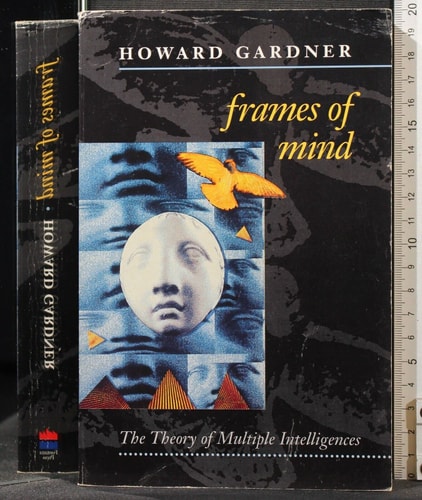
Frames of Mind: The Theory of Multiple Intelligences
0
0
As an Amazon Associate and affiliate partner, Menrva Books earns from qualifying purchases. Learn more
Author Description
The author demonstrates that there exist many human "intelligences", common to all cultures - each with its own pattern of development and brain activity, and each different in kind from the others. These potentials include linguistic, musical and logical/mathematical capacities, as well as spatial and bodily intelligences, and the ability to arrive at an emotional and mental sense of self and other people. Rather than reducing an individual's potential to a single score on an IQ test, it is the fostering and education of all these intelligences that should be our concern.
Menrva's Summary
THE THESIS
This work investigates the limitations of traditional psychometric testing by proposing that human intelligence is not a singular, monolithic entity but a collection of distinct, autonomous faculties. Howard Gardner, a professor at Harvard University, draws upon extensive research in neurology, developmental psychology, and anthropology to challenge the conventional reliance on IQ scores. He argues that human potential is multifaceted, requiring an educational framework that recognizes and nurtures diverse cognitive strengths rather than prioritizing a narrow set of logical and linguistic skills.
THE SCOPE MAP
What You Will Find
- A comprehensive framework defining seven distinct intelligences including linguistic, musical, logical-mathematical, spatial, bodily-kinesthetic, interpersonal, and intrapersonal.
- Analysis of the biological and neurological foundations for each intelligence type.
- Case studies and observational data from diverse cultural contexts to demonstrate the universality of these cognitive patterns.
- A critique of standardized testing and its failure to capture the full spectrum of human capability.
THE AUTHORITY PERSPECTIVE
This text is widely regarded as a foundational work in educational theory, shifting the focus of pedagogical research toward individualized learning strategies. The framing suggests a dense, academic exploration that remains accessible to educators and psychologists seeking to broaden their understanding of cognitive development.
Page Count:
464
Publication Date:
1993-01-01
Publisher:
Fontana Press Harpercollins
ISBN-10:
000686290X
ISBN-13:
9780006862901
Non-Fiction
Psychology
Philosophy of
Developmental Psychology
Psychology
Pedagogy
Education
Intelligence
Community Tags
Similar Books