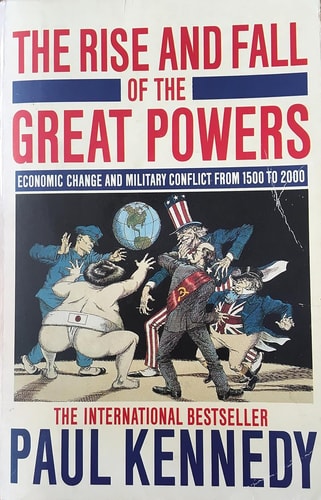
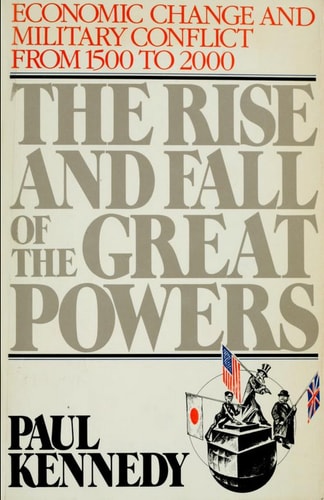
The Rise and Fall of the Great Powers: Economic Change and Military Conflict from 1500 to 2000
0
0
As an Amazon Associate and affiliate partner, Menrva Books earns from qualifying purchases. Learn more
Author Description
This study describes how the past 500 years shows that nations which became great powers had to decline as their growth rate slowed and their spending on defence continued to increase and explains how this can be eased or worsened by clever or short-sighted policy decisions. The final chapter looks at the current dilemna of the USA, the USSR, the EEC, Japan and China, and peers. Paul Kennedy also wrote "Strategy and Diplomacy, 1870-1945" and "The Realities Behind Diplomacy, 1865-1980"
Menrva's Summary
THE THESIS
This work investigates the recurring historical pattern wherein the economic growth of great powers eventually falters under the weight of excessive military expenditure, leading to relative decline. Paul Kennedy, a distinguished historian of international relations, utilizes a vast historical dataset spanning five centuries to demonstrate the correlation between industrial capacity and global influence. He argues that the sustainability of a nation's position in the international order depends on maintaining a delicate balance between productive economic investment and the costs of maintaining global security commitments.
THE SCOPE MAP
What You Will Find
- A comprehensive analysis of global power shifts from the year 1500 through the end of the 20th century.
- The concept of 'imperial overstretch' as a primary driver of geopolitical decline.
- Comparative economic data regarding industrial output, trade, and military spending across major empires.
- An examination of the strategic dilemmas facing the United States, the Soviet Union, and emerging powers like China and Japan.
THE AUTHORITY PERSPECTIVE
This text is widely regarded as a seminal contribution to the study of geopolitical history and the economic foundations of state power. Its rigorous historical framework and predictive capacity regarding the long-term trajectories of nations remain highly influential in academic and policy circles.
Page Count:
928
Publication Date:
1989-01-01
Publisher:
Harper Collins Publishers
ISBN-10:
0006860524
ISBN-13:
9780006860525
History
Economics
Military
Economics
History - Modern
International relations
Military History
War
Engineering
Military Technology
Economic History
Geopolitics
Community Tags
Other Editions(3)
Similar Books