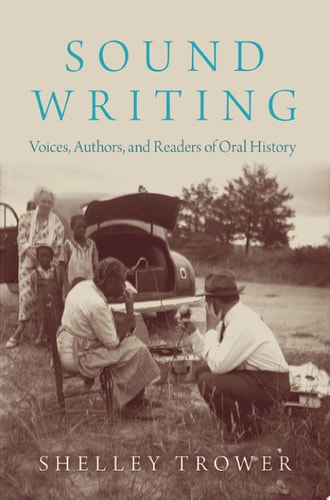
Sound Writing: Voices, Authors, and Readers of Oral History
0
0
As an Amazon Associate and affiliate partner, Menrva Books earns from qualifying purchases. Learn more
Author Description
The concept that oral history can give voice to people or allow "hidden voices" to become part of history is one of its most celebrated achievements. However, the standard practice of transcribing or summarizing interviews has meant that oral historians have had to grapple with questions of how to translate the oral into written form. What is lost or gained during this process of mediation? These re-creations can be wonderful and illuminating works of scholarship and art, and this book explores a wide range of the different forms they have taken-from John and Alan Lomax's transcriptions of African American songs for the Federal Writers Project to Svetlana Alexievich's polyphonic novels. Such works can give their subjects the necessary latitude to convey their narratives on their own terms, but there is also, always, the danger that their voices will be distorted or lost during the process of mediation.Sound Writing offers a thorough review of the varying arguments about editing for transcription and publication and reflects on how digital technologies enable much wider access to "raw" oral data. It examines how oral histories are co-created by speakers, the authors who mediate them, and readers, and it brings into sharp focus questions about how memory takes on subjective, narrative form. Finally, it examines the interplay between written literature and sound recordings, or orality, using a diverse range of examples-from the work of William Wordsworth and George Ewart Evans to Studs Terkel, Alex Haley, Luisa Passerini, Amrit Wilson, and Stacy Zembrzycki. As an interdisciplinary study, Sound Writing takes a broad approach to the written word to encompass not only transcriptions and other texts derived from oral history interviews but also literary precursors such as epic poetry and folklore, along with various related textual forms such as biography, autobiography, and blogs. It argues that the recording of oral traditions in print by poets, folklorists, anthropologi
Menrva's Summary
THE THESIS
How does the process of transcribing and editing oral history interviews fundamentally alter the authenticity and narrative integrity of the original spoken word? Professor Emeritus Shelley Trower investigates the complex mediation between oral testimony and written text, drawing upon her expertise in English literature and historical methodology. She argues that the transformation of sound into print is not a neutral act but a co-creative process that shapes how memory is preserved, distorted, or amplified for the reader.
THE SCOPE MAP
What You Will Find
- Analysis of transcription practices from the Federal Writers Project to contemporary digital archives.
- Examination of the interplay between oral traditions, folklore, and literary forms like biography and epic poetry.
- Case studies involving figures such as Svetlana Alexievich, Studs Terkel, and William Wordsworth.
- Discussion on the impact of digital technology on the accessibility of raw audio data.
Scope Limits
- The text does not provide a technical manual for conducting oral history interviews.
- It does not focus on the legal or ethical frameworks of institutional review boards.
THE AUTHORITY PERSPECTIVE
Scholars in the field of oral history identify this work as a significant interdisciplinary contribution to the study of narrative mediation. Readers frequently note the academic density of the prose, which effectively bridges the gap between literary theory and historical practice.
Page Count:
216
Publication Date:
2023-08-15
Publisher:
Oxford University Press
ISBN-10:
0190905999
ISBN-13:
9780190905996
Historiography
Oral History
Literary Criticism
Communication Studies
Criticism & Theory
Anthropology
Community Tags
Similar Books