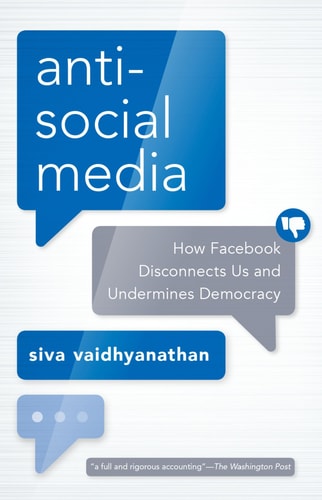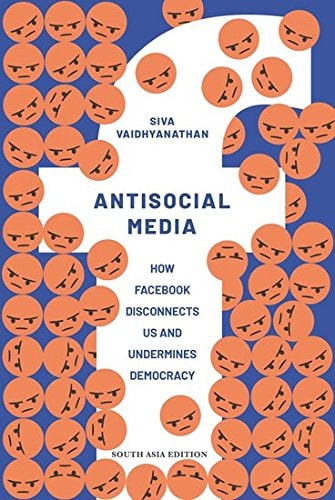
Antisocial Media: How Facebook Disconnects Us and Undermines Democracy
0
0
As an Amazon Associate and affiliate partner, Menrva Books earns from qualifying purchases. Learn more
Author Description
If you wanted to build a machine that would distribute propaganda to millions of people, distract them from important issues, energize hatred and bigotry, erode social trust, undermine respectable journalism, foster doubts about science, and engage in massive surveillance all at once, you would make something a lot like Facebook. Of course, none of that was part of the plan.In Antisocial Media, Siva Vaidhyanathan explains how Facebook devolved from an innocent social site hacked together by Harvard students into a force that, while it may make personal life just a little more pleasurable, makes democracy a lot more challenging. It's an account of the hubris of good intentions, a missionary spirit, and an ideology that sees computer code as the universal solvent for all human problems. And it's an indictment of how "social media" has fostered the deterioration of democratic culture around the world, from facilitating Russian meddling in support of Trump's election to the exploitation of the platform by murderous authoritarians in Burma and the Philippines.Facebook grew out of an ideological commitment to data-driven decision making and logical thinking. Its culture is explicitly tolerant of difference and dissent. Both its market orientation and its labor force are global. It preaches the power of connectivity to change lives for the better. Indeed, no company better represents the dream of a fully connected planet "sharing" words, ideas, and images, and no company has better leveraged those ideas into wealth and influence. Yet no company has contributed more to the global collapse of basic tenets of deliberation and democracy. Both authoritative and trenchant, Antisocial Media shows how Facebook's mission went so wrong.
Menrva's Summary
THE THESIS
This book investigates how Facebook’s architectural design and corporate ideology have inadvertently facilitated the erosion of democratic institutions and global social trust. Siva Vaidhyanathan, a professor of media studies and director of the Center for Media and Citizenship at the University of Virginia, utilizes a combination of historical analysis, media theory, and case studies to argue that the platform's reliance on algorithmic engagement incentivizes polarization and misinformation. He posits that the company's foundational belief in technological solutionism has blinded its leadership to the systemic harms caused by its global expansion.
THE SCOPE MAP
What You Will Find
- Analysis of Facebook’s corporate culture and its commitment to data-driven decision making.
- Examination of how algorithmic curation prioritizes sensationalism over deliberative discourse.
- Case studies detailing the platform's role in political instability in Burma, the Philippines, and the United States.
Scope Limits
- The text does not provide a comprehensive technical manual for Facebook’s internal software engineering processes.
- It does not offer a detailed roadmap for legislative regulation or specific policy reform.
THE AUTHORITY PERSPECTIVE
Experts and critics frequently cite this work as a foundational critique of the platform's impact on global political culture. Readers often note the accessible yet rigorous nature of the prose, which balances academic theory with clear, real-world examples of platform failure.
Page Count:
288
Publication Date:
2001-01-01
Publisher:
OXFORD UNIVERSITY PRESS
ISBN-10:
019093316X
ISBN-13:
9780190933166
Politics
Sociology
Technology
Media Studies
Democracy
Subjects