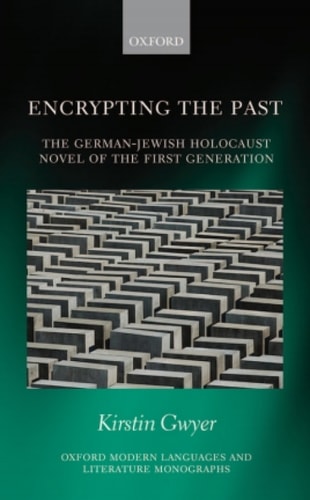
Encrypting the Past: The German-Jewish Holocaust Novel of the First Generation
0
0
As an Amazon Associate and affiliate partner, Menrva Books earns from qualifying purchases. Learn more
Author Description
Encrypting the Past puts forward the interpretative category of the first-generation German-Jewish Holocaust novel and examines its representational strategies. With reference to works by H.G. Adler, Jenny Aloni, Elisabeth Augustin, Erich Fried, and Wolfgang Hildesheimer, and a concluding section on W.G. Sebald, it shows how Holocaust literature was being written decades before postwar authors such as Sebald were credited with having found new ways of reflecting the unspeakable. It demonstrates that, before the theoretical debate over the fundamental representability of the Holocaust was even fully under way, first-generation authors were already translating un-narratable trauma into a literary strategy of un-narrating: a strategy of encrypting the Holocaust into the form and structure of their texts. The implications of treating these writers as a set, and their body of work as a hitherto unacknowledged category of Holocaust fiction, go well beyond drawing attention to a number of important but critically neglected authors. This study frames the analysis of first-generation narrative strategies in the broader debate on the ethics and aesthetics of Holocaust writing. In revealing how certain kinds of testimony have been privileged above others in international Holocaust studies, it raises questions of a more general nature concerning canon formation and our theoretical responses to the Holocaust. In considering foremost among these responses the theory of deconstruction and trauma theory, it finally invites a re-examination of the relationship between the (post-)modern and trauma.
Menrva's Summary
THE THESIS
This study investigates the representational strategies of first-generation German-Jewish Holocaust novels to determine how these authors translated un-narratable trauma into specific literary structures. Kirstin Gwyer, an academic specializing in modern languages and literature, utilizes a comparative analysis of authors such as H.G. Adler, Jenny Aloni, and W.G. Sebald to challenge the prevailing timeline of Holocaust literature. She argues that these writers developed a technique of 'un-narrating' or encrypting trauma long before postwar theoretical debates on representability gained prominence in the literary canon.
THE SCOPE MAP
What You Will Find
- Analysis of narrative strategies in works by H.G. Adler, Jenny Aloni, Elisabeth Augustin, Erich Fried, and Wolfgang Hildesheimer.
- A critical examination of W.G. Sebald’s relationship to earlier Holocaust literature.
- Application of deconstruction and trauma theory to the ethics and aesthetics of Holocaust writing.
- A critique of canon formation and the privileging of specific types of testimony in international studies.
Scope Limits
- The study focuses specifically on the 'first-generation' German-Jewish perspective rather than a comprehensive survey of all Holocaust literature.
- The analysis is limited to the literary strategies of encryption and does not cover oral history or non-literary archival testimony.
THE AUTHORITY PERSPECTIVE
Scholars and critics recognize this monograph as a significant contribution to the study of Holocaust literature and the history of trauma representation. Readers frequently note the academic density of the prose, which is intended for researchers and students engaged in advanced literary theory and German-Jewish studies.
Page Count:
256
Publication Date:
2014-01-01
Publisher:
OUP Oxford
ISBN-10:
0191019917
ISBN-13:
9780191019913
Literary Criticism
Authors German
Trauma Theory
English
English & College Success
German
Jewish Studies
Jewish authors
Community Tags
Similar Books