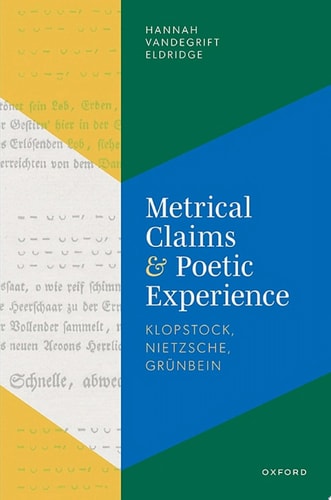
Metrical Claims and Poetic Experience: Klopstock, Nietzsche, Grünbein
0
0
As an Amazon Associate and affiliate partner, Menrva Books earns from qualifying purchases. Learn more
Author Description
This volume contributes to the fields of lyric poetry and poetics (especially poetic form), aesthetics, and German literature by intervening in debates on the social functions, cognitive and emotional effects, and the value of poetry. It builds on, and moves beyond, previous theories of rhythm to tie meter more particularly to the specificities of poetic language in blending of embodied responses, cultural situations, and linguistic particularities. The book examines the German-language tradition across three centuries, arguing that the interdisciplinarity and richness of metrical theory and practice emerge in the heterogeneity of poetry and its defenders in their specific historical moments. Focusing on Friedrich Gottlieb Klopstock, Friedrich Nietzsche, and Durs Grünbein, the book contextualizes each in the metrical and aesthetic debates of his epoch, showing how questions of meter are linked with overarching poetic goals such as the relationship between form and meaning, the adaptation of the Classical past for German literature, and the ways poetry's sounds work in the body. It argues that Klopstock's, Nietzsche's, and Grünbein's metrical theory and practice offer valuable insights for thinking about the ways poetry works and why it matters.
Menrva's Summary
THE THESIS
This volume investigates how the technical mechanics of meter in German lyric poetry function as a bridge between linguistic structure, embodied human experience, and historical cultural contexts. Hannah Vandegrift Eldridge, a scholar of German literature, synthesizes historical metrical theory with contemporary aesthetic debates. She argues that meter is not merely a formal constraint but a dynamic site where poets negotiate the relationship between sound, meaning, and the physical body across three centuries of literary production.
THE SCOPE MAP
What You Will Find
- Analysis of the metrical theories and poetic practices of Friedrich Gottlieb Klopstock, Friedrich Nietzsche, and Durs Grünbein.
- A framework for understanding how poetic form adapts Classical traditions to the German language.
- Examination of the intersection between cognitive response, emotional effect, and linguistic rhythm.
Scope Limits
- The study is restricted to the German-language tradition and does not provide a comprehensive survey of global metrical practices.
- The analysis focuses specifically on the selected three authors rather than providing an exhaustive history of German prosody.
THE AUTHORITY PERSPECTIVE
Scholars in the field of poetics recognize this work as a significant contribution to the study of German literary form and aesthetic theory. Readers frequently note the academic density of the prose and the precision with which the author connects abstract metrical concepts to concrete historical and linguistic examples.
Page Count:
547
Publication Date:
2022-01-01
Publisher:
OUP Oxford
ISBN-10:
0192675311
ISBN-13:
9780192675316
Philosophy
English & College Success
German
Poetics
Academic
Aesthetics
Literary Criticism
English
Community Tags
Similar Books