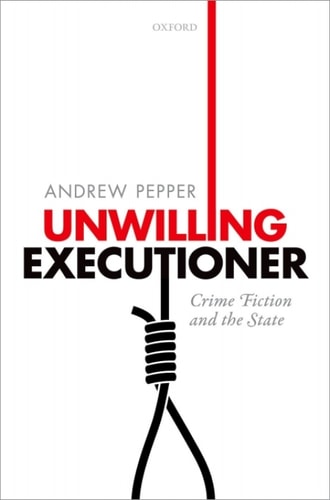
Unwilling Executioner: Crime Fiction and the State
0
0
As an Amazon Associate and affiliate partner, Menrva Books earns from qualifying purchases. Learn more
Author Description
What gives crime fiction its distinctive shape and form? What makes it such a compelling vehicle of social and political critique? Unwilling Executioner argues that the answer lies in the emerging genre's complex and intimate relationship with the bureaucratic state and modern capitalism, and the contradictions that ensue once the state assumes control of the criminal justice system. This study offers a dramatic new interpretation of the genre's emergence and evolution over a three hundred year period and as a genuinely transnational phenomenon. From its roots in the tales of criminality circulated widely in Paris and London in the early eighteenth century, this book examines the extraordinary richness, diversity and complexity of the genre's subsequent thematizations of crime and policing--moving from France and Britain and from continental Europe and the United States to other parts of the globe. In doing so it offers new ways of reading established crime novelists like Gaboriau, Doyle, Hammett, and Simenon, beyond their national contexts and an impulse to characterize their work as either straightforwardly 'radical' or 'conservative'. It also argues for the centrality of writers like Defoe, Gay, Godwin, Vidocq, Morrison, and more recently Manchette, Himes, and Sjöwall and Wahlöö to a project where crime and policing are rooted, and shown to be rooted, in the social and economic conditions of their time. These are all deeply political writers even if their novels exhibit no interest in directly promoting political causes or parties. The result is an agile, layered, and far-reaching account of the crime story's ambivalent relationship to the justice system and its move to complicate our understanding of what crime is and how society is policed and for whose benefit.
Menrva's Summary
THE THESIS
This book investigates the structural relationship between the evolution of crime fiction and the development of the bureaucratic state and modern capitalism. Andrew Pepper, a scholar of crime fiction and American literature, utilizes a historical and transnational framework to argue that the genre functions as a critical vehicle for examining the contradictions inherent in state-controlled criminal justice systems. By analyzing the works of authors from the eighteenth century to the present, the text posits that crime fiction is inherently political, reflecting the socio-economic conditions of its era regardless of the author's explicit ideological intent.
THE SCOPE MAP
What You Will Find
- A historical analysis spanning three hundred years of crime literature.
- A transnational comparative framework covering France, Britain, the United States, and other global regions.
- Critical re-evaluations of authors including Defoe, Gaboriau, Doyle, Hammett, Simenon, Himes, and Sjöwall and Wahlöö.
- An examination of the intersection between policing, justice, and economic structures.
Scope Limits
- The study does not focus on contemporary digital-era crime fiction or sub-genres like the cozy mystery.
- It avoids binary classifications of authors as purely radical or conservative, focusing instead on systemic critique.
THE AUTHORITY PERSPECTIVE
Scholars and critics recognize this work as a significant contribution to the study of genre evolution and its political implications. Readers frequently note the academic density of the prose, which provides a rigorous framework for understanding the crime novel as a complex social document.
Page Count:
288
Publication Date:
2016-01-01
Publisher:
OUP Oxford
ISBN-10:
0191025313
ISBN-13:
9780191025310
History
Crime fiction
English & College Success
Literary Criticism
In literature
Sociology
English
Community Tags
Similar Books