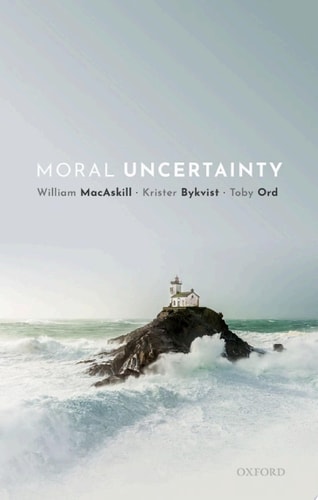
Moral Uncertainty
0
0
As an Amazon Associate and affiliate partner, Menrva Books earns from qualifying purchases. Learn more
Author Description
This is an open access title available under the terms of a CC BY-NC-ND 4.0 International licence. It is free to read at Oxford Scholarship Online and offered as a free PDF download from OUP and selected open access locations. Very often we're uncertain about what we ought, morally, to do. We don't know how to weigh the interests of animals against humans, how strong our duties are to improve the lives of distant strangers, or how to think about the ethics of bringing new people into existence. But we still need to act. So how should we make decisions in the face of such uncertainty? Though economists and philosophers have extensively studied the issue of decision-making in the face of uncertainty about matters of fact, the question of decision-making given fundamental moral uncertainty has been neglected. Philosophers William MacAskill, Krister Bykvist, and Toby Ord try to fill this gap. Moral Uncertainty argues that there are distinctive norms that govern how one ought to make decisions. It defends an information-sensitive account of how to make such decisions by developing an analogy between moral uncertainty and social choice, arguing that the correct way to act in the face of moral uncertainty depends on whether the moral theories in which one has credence are merely ordinal, cardinal, or both cardinal and intertheoretically comparable. It tackles the problem of how to make intertheoretical comparisons, discussing potential solutions and the implications of their view for metaethics and practical ethics.
Menrva's Summary
THE THESIS
This book investigates the normative principles that should govern human decision-making when an individual faces fundamental uncertainty regarding which moral theory is correct. The authors, William MacAskill, Krister Bykvist, and Toby Ord, utilize a framework rooted in decision theory and social choice to address a gap in philosophical literature. They argue that the optimal approach to action under moral uncertainty depends on the nature of one's credence in competing moral theories, specifically whether those theories are ordinal, cardinal, or intertheoretically comparable.
THE SCOPE MAP
What You Will Find
- An information-sensitive account of decision-making under moral uncertainty.
- An analogy between moral uncertainty and social choice theory.
- Analysis of intertheoretical comparisons and their implications for practical ethics.
Scope Limits
- The text does not provide a definitive resolution to specific moral dilemmas, but rather a framework for how to act when the correct moral theory is unknown.
- It does not focus on empirical decision-making under factual uncertainty, which is treated as a separate domain.
THE AUTHORITY PERSPECTIVE
Experts recognize this work as a foundational text for the study of moral uncertainty, noting its rigorous application of formal decision theory to ethical problems. Readers frequently highlight the technical density of the prose, which assumes a background in analytic philosophy or formal logic.
Page Count:
240
Publication Date:
2020-01-01
Publisher:
OUP Oxford
ISBN-10:
0191033642
ISBN-13:
9780191033643
Philosophy
Decision Theory
Ethics
Practical Ethics
Metaethics
Community Tags
Similar Books