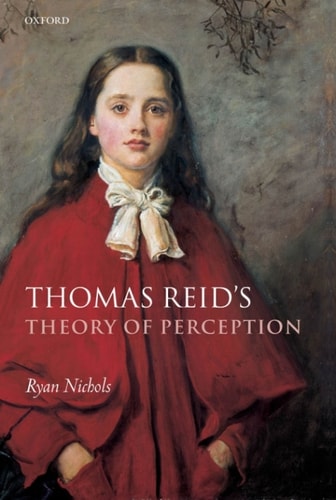
Thomas Reid's Theory of Perception
0
0
As an Amazon Associate and affiliate partner, Menrva Books earns from qualifying purchases. Learn more
Author Description
The thesis that the mind cannot directly apprehend features of the physical world - what Reid calls the Way of Ideas - is a staple of Early Modern philosophical tradition. This commitment to the direct awareness of, and only of, mental representations unifies the otherwise divergent philosophical systems of Rationalists and Empiricists. Thomas Reid battles against this thesis on many fronts, in particular over the nature of perception. Ryan Nichols lays the groundwork for Reid's theory of perception by developing Reid's unheralded argument against a representational theory of thought, which Nichols applies to his discussion of the intentionality of perceptual states and Reid's appeal to 'signs'. Reid's efforts to preserve common sense epistemic commitments also lead him to adopt unique theories about our concepts of primary and secondary qualities, and about original and acquired perceptions. About the latter pair, Nichols argues that most perceptual beliefs depend for their justification upon inferences. The Way of Ideas holds that sensations are objects of awareness and that our senses are not robustly unified. Nichols develops Reid's counter-proposals by examining his discussion of the evolutionary purpose of sensations, and the nature of our awareness of sensations, as well as his intriguing affirmative answer to Molyneux's questions. Nichols brings to the writing of this book a consummate knowledge of Reid's texts, published and unpublished, and a keen appreciation for Reid's responses to his predecessors. He frequently reconstructs arguments in premise/conclusion form, thereby clarifying disputes that have frustrated previous Reid scholarship. This clarification, his lively examples, and his plainspoken style make this book especially readable. Reid's theory of perception is by far the most important feature of Reid's philosophical system, and Nichols offers what will be, for a long time to come, the definitive analysis of this theory.
Menrva's Summary
THE THESIS
This book investigates the core question of how Thomas Reid challenges the Early Modern philosophical tradition known as the Way of Ideas, specifically regarding the nature of human perception. Ryan Nichols, a scholar of Reid’s work, utilizes both published and unpublished texts to reconstruct Reid’s arguments against representationalism. By applying a rigorous analytical framework, Nichols demonstrates how Reid’s defense of common sense epistemic commitments provides a robust alternative to the prevailing Rationalist and Empiricist systems of the era.
THE SCOPE MAP
What You Will Find
- Analysis of Reid’s arguments against the representational theory of thought
- Examination of intentionality in perceptual states and the role of signs
- Discussion of primary and secondary qualities alongside original and acquired perceptions
- Reconstructions of philosophical arguments in premise-conclusion form
Scope Limits
- The text focuses primarily on Reid’s theory of perception rather than his broader moral or political philosophy
- The analysis is limited to the context of Early Modern debates and does not provide a comprehensive history of 18th-century philosophy
THE AUTHORITY PERSPECTIVE
Scholars frequently note that Nichols provides a high level of clarity by formalizing complex arguments that have historically frustrated researchers. Experts highlight this work as a significant contribution to Reid scholarship due to its meticulous use of primary sources and its accessible, plainspoken prose style.
Page Count:
317
Publication Date:
2007-01-01
Publisher:
Clarendon Press
ISBN-10:
0191534978
ISBN-13:
9780191534973
Philosophy
Perception
Thomas Reid
Mind & Body
Early Modern
Epistemology
Community Tags
Similar Books