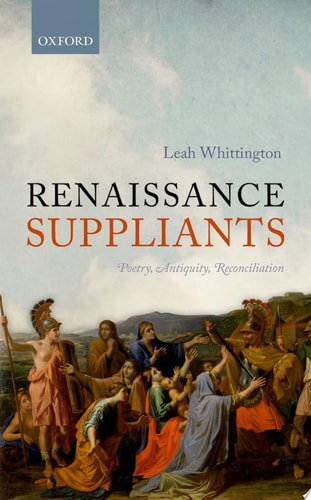
Renaissance Suppliants
0
0
As an Amazon Associate and affiliate partner, Menrva Books earns from qualifying purchases. Learn more
Author Description
Renaissance Suppliants studies supplication as a social and literary event in the long European Renaissance. It argues that scenes of supplication are defining episodes in a literary tradition stretching back to Greco-Roman antiquity, taking us to the heart of fundamental questions of politics and religion, ethics and identity, sexuality and family. As a perennial mode of asymmetrical communication in moments of helplessness and extreme need, supplication speaks to ways that people live together despite grave inequalities. It is a strategy that societies use to regulate and perpetuate themselves, to negotiate conflict, and to manage situations in which relationships threaten to unravel. All the writers discussed here—Vergil, Petrarch, Shakespeare, and Milton—find supplication indispensable for thinking about problems of antagonism, difference, and hierarchy, bringing the aesthetic resources of supplicatory interactions to bear on their unique literary and cultural circumstances. The opening chapters establish a conceptual framework for thinking about supplication as facilitating transitions between states of feeling and positions of relative status, beginning with Homer and classical literature. Vergil's Aeneid is a paradigmatic instance in which literary and social structures of the ancient past are transformed to suit the needs of the present, and supplication becomes a figure for the act of cultural translation. Subsequent chapters take up different aspects of Renaissance supplicatory discourse, showing how postures of humiliation and abjection are appropriated and transformed in erotic poetry, drama, and epic. The book ends with Milton who invests gestures of self-abasement with unexpected dignity.
Menrva's Summary
THE THESIS
This book investigates supplication as a critical social and literary mechanism that defines power dynamics and human interaction throughout the long European Renaissance. Leah Whittington, a scholar of Renaissance literature, utilizes a comparative framework to analyze how authors from antiquity to the seventeenth century employed scenes of supplication to navigate hierarchy, conflict, and identity. By examining the aesthetic and ethical dimensions of these interactions, the author argues that supplication serves as a vital tool for managing social instability and expressing complex human needs.
THE SCOPE MAP
What You Will Find
- A conceptual framework for supplication as a transition between emotional states and social status.
- Comparative analysis of Vergil, Petrarch, Shakespeare, and Milton.
- Examination of supplication across erotic poetry, drama, and epic genres.
Scope Limits
- The study focuses primarily on the Western literary tradition and does not provide an exhaustive global history of the practice.
- The analysis is restricted to specific canonical authors rather than a broad survey of minor Renaissance writers.
THE AUTHORITY PERSPECTIVE
Scholars recognize this work as a significant contribution to the study of Renaissance social discourse and literary form. Readers frequently note the academic density of the prose, which provides a rigorous examination of how classical tropes were adapted by later authors.
Page Count:
288
Publication Date:
2016-01-01
Publisher:
Oxford University Press
ISBN-10:
019106940X
ISBN-13:
9780191069406
History
Classical
Political Theory
Literary Criticism
Community Tags
Similar Books